July 20, 2026· 7 min read
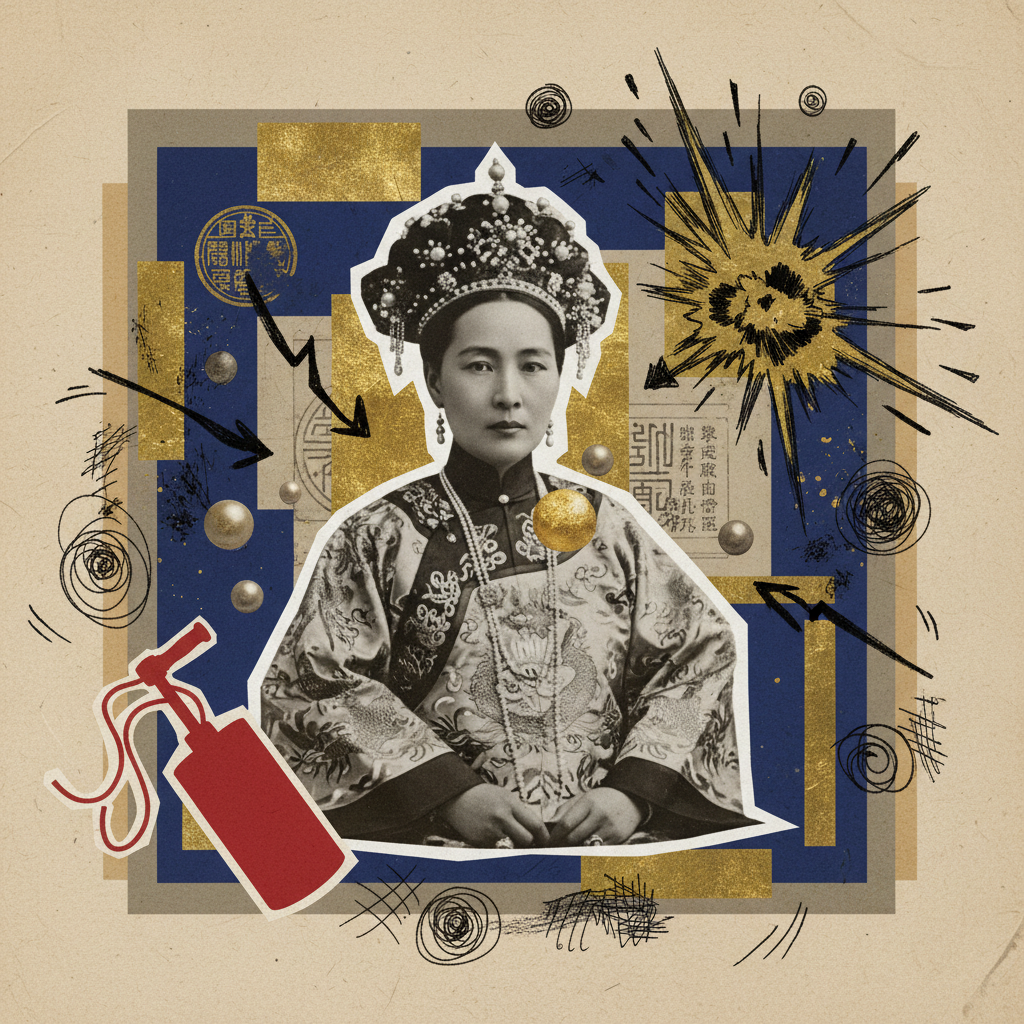
The Emperor Who May Be Sleeping in a River of Mercury
Qin Shi Huang's sealed tomb reportedly contains 100 tons of flowing liquid mercury, and modern science has confirmed the ancient claim — yet still cannot safely open it.

Strange Fact
Beneath a man-made mountain in central China, the first emperor of a unified China may be lying inside a palace where rivers of liquid mercury flow across the floor. This is not legend. It is a claim written down over two thousand years ago, tested by modern chemistry, confirmed by satellite imaging, and still, as of today, completely beyond our ability to safely investigate.
The tomb of Qin Shi Huang has never been opened. Not because no one wants to. Because we genuinely do not know how.
Historical Background
Qin Shi Huang unified China's warring kingdoms in 221 BCE and immediately began work on two things: the Great Wall, and his own tomb. He was thirteen years old when construction on the burial complex started. It would take an estimated 700,000 workers and nearly four decades to complete.
The tomb sits beneath Mount Li, a burial mound roughly 76 metres tall and 350 metres wide, located in Shaanxi Province. It is surrounded by a vast necropolis that includes the now-famous Terracotta Army, discovered by farmers in 1974. That army alone - more than 8,000 figures of soldiers, horses, and chariots - represents only the outer edge of what the site contains.
The burial chamber itself has never been touched.
Sima Qian, the grand historian of the Han Dynasty writing around 100 BCE, described the interior in his monumental work Records of the Grand Historian. He wrote that craftsmen had constructed a scale model of the empire inside the tomb. The ceiling was studded with pearls arranged to represent the stars. And the rivers - the Yellow River, the Yangtze, and the great sea - were recreated using flowing liquid mercury, kept in motion by mechanical devices.
For most of recorded history, scholars read this as poetry. Beautiful exaggeration. A metaphor for imperial ambition.
Then scientists started testing the soil.
What Happened
The Chemistry of a Rumour
In 1981, and again in 2002, researchers collected soil samples from the burial mound and analysed them for heavy metal content. What they found was difficult to dismiss.
Mercury concentrations in the soil were nearly 100 times higher than natural background levels for the region. More striking than the quantity was the distribution. The mercury did not simply pool in one location. It spread across the mound in a pattern that, when mapped, closely mirrored the ancient hydrological geography of the Qin Empire. The highest concentrations appeared in the northeast portion of the mound, exactly where the Bohai Sea would sit on a map of the empire.
Sima Qian, it seemed, had not been writing poetry.
A 2020 study published in Scientific Reports added further detail using airborne lidar technology to produce high-resolution scans of the burial mound. The imaging revealed the internal architecture of the complex, including what appear to be intact chambers and corridors arranged beneath the mound's surface. The structure has remained essentially undisturbed for over two millennia.
The Trees That Warn You Off
The mound itself offers a quieter kind of evidence. The landscape surrounding Mount Li is green and productive. The pomegranate trees growing on the mound are not. They are stunted, reaching barely half the height of trees a few metres away. Their leaves carry elevated mercury content. Their fruit is toxic.
Researchers believe the trees are absorbing mercury vapour that has been slowly escaping through micro-fractures in the tomb structure for more than 2,200 years. The mound breathes poison. What that implies about concentrations inside the sealed chamber is not a comfortable thought.
Without ventilation, mercury vapour accumulates. In an enclosed space over centuries, the levels inside the tomb could be extraordinary. Breaching the chamber without preparation would not simply be dangerous. It could be immediately fatal to anyone standing nearby, and could disperse contamination into the surrounding environment.
The Lesson the Terracotta Warriors Already Taught Us
There is a second reason the tomb remains sealed, and it is in some ways more humbling than the poison problem.
When the Terracotta Warriors were excavated beginning in 1974, many of them retained their original paint. The soldiers had been colourful: red armour, green tunics, pink faces, black hair. Within minutes of exposure to air, the paint began to curl and flake. Within a short time, it was gone. Decades of work by conservators have since produced methods to slow this process, but the loss from those early excavations cannot be recovered.
The burial chamber of Qin Shi Huang is expected to contain objects of far greater delicacy and historical significance than the outer warrior pits. Opening it before conservation science is ready would mean watching irreplaceable artefacts disintegrate in real time. Chinese authorities, along with international archaeologists, have made the deliberate decision to wait.
This is the part of the story that does not often get told: the tomb is sealed not only because we are afraid of what is inside. It is sealed because we respect it too much to open it badly.
Why It Was Strange
The strangeness here operates on several levels.
First, there is the sheer audacity of the original engineering. The claim that ancient craftsmen constructed a functional, flowing mercury landscape inside a buried palace, driven by mechanical systems, describes an ambition that would be impressive in any era. That it was apparently achieved in the third century BCE, using materials sourced and refined at enormous scale, is extraordinary.
- Mercury does not occur in useful quantities everywhere. Sourcing 100 tons of it would have required a significant extraction and refining operation across multiple sites.
- Keeping liquid mercury in motion inside a sealed underground chamber requires mechanical ingenuity that archaeological science has not yet been able to fully reconstruct.
- The preservation of that mercury across 2,200 years, evidenced by the soil data, suggests the chamber was sealed with unusual effectiveness.
Second, there is the matter of verification. Sima Qian wrote his account roughly a century after the tomb was sealed. He was not a witness. He drew on official records and oral accounts. The fact that his description of the mercury rivers has been corroborated, in geographic detail, by soil testing performed 2,100 years later using methods he could not have imagined, is the kind of coincidence that makes historians stop and stare.
Third, there is the humility of the present moment. We live in an era of extraordinary technological capability. We can map the chambers beneath the mound without touching it. We can detect the vapour rising through the soil. We can read the evidence in the leaves of a stunted pomegranate tree. And we still cannot open the door.
Historical Legacy
The tomb of Qin Shi Huang is formally protected under Chinese law, and the government has stated that it will not be excavated until conservation technology is adequate to preserve what lies inside. That threshold has not yet been reached.
This is, in the context of archaeological history, an unusual situation. The default posture of archaeology for most of its existence has been to dig. Schliemann dug Troy with a pickaxe. Carter opened Tutankhamun's tomb under conditions that, by modern standards, were poorly controlled. The instinct to open, to see, to retrieve, has been the engine of the discipline.
The decision to leave Qin Shi Huang's tomb sealed represents a different approach: the acknowledgement that restraint, in archaeology as elsewhere, can itself be a form of knowledge.
The mercury rivers, if they exist as described, have been flowing for over two thousand years. They can wait a little longer.
What the chamber contains - the pearls arranged as stars, the mechanical rivers, the body of the man who first called himself emperor of China - remains one of the most significant unopened questions in world history. The answer is there, beneath the mountain, saturating the soil, rising through the roots of poisoned trees.
We simply are not ready to read it yet.
Sources
See below.

Written by
The History, But Strange Team
We dig into the weirdest, strangest, and most forgotten corners of real history. From bizarre royal scandals to unusual medical practices and darkly funny disasters, our team researches and writes about the stories your textbooks left out.