Royal Courts
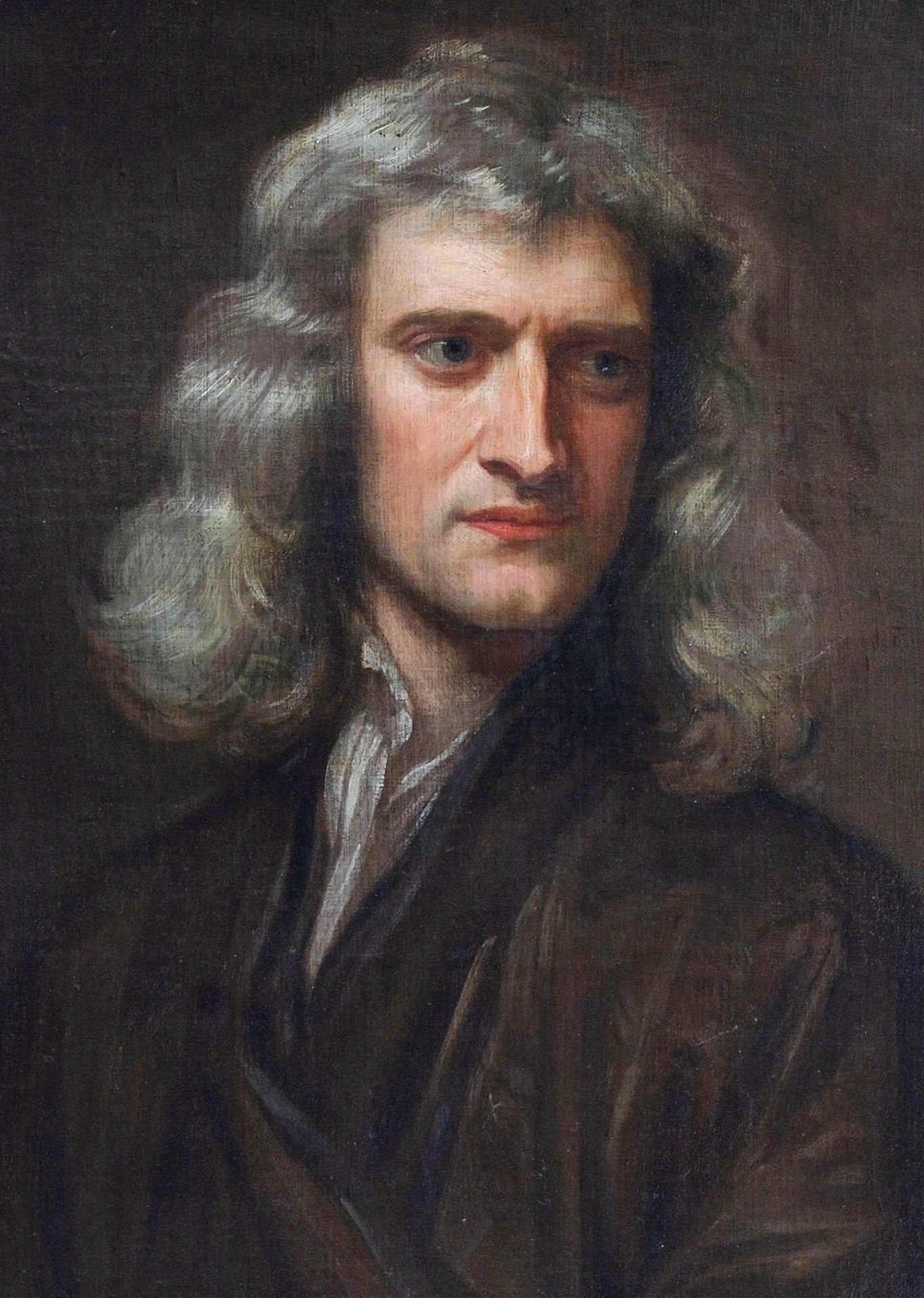
Sir Isaac Newton
Physicist, Mathematician, and Master of the Mint
Biography
The Mad Scientist
Most people know Sir Isaac Newton as the brilliant mind who formalized the laws of gravity when an apple supposedly fell on his head. But behind his revolutionary work in physics and calculus, Newton was deeply eccentric, reclusive, and recklessly curious. When it came to using his own physical body for science, no experiment was too extreme. In his pursuit to understand optics, he literally stared at the sun for as long as he could bear, almost blinding himself in the process. Even more unhinged? He once inserted a bodkin (a thick, blunt sewing needle) deep into his own eye socket, pressing it against the back of his eyeball just to document what colors and shapes he would perceive from the pressure.
The Alchemical Obsession
While he birthed modern physics, Newton’s true passion was surprisingly mystical. He wrote over a million words on alchemy—the occult science of turning base metals into gold and seeking the elusive elixir of life.
- He spent decades searching for the legendary Philosopher’s Stone.
- He secretly analyzed biblical codes and prophecies, calculating that the end of the world wouldn't happen before the year 2060.
- His obsessive, unventilated laboratory experiments with toxic metals likely gave him severe mercury poisoning, which modern historians believe explains his infamous nervous breakdown and paranoia in 1693.
Crime Fighter at the Mint
Later in life, Newton pivoted from bizarre laboratory experiments to a ruthless government career. Appointed as the Warden (and later Master) of the Royal Mint, he surprisingly became an uncompromising crime fighter. Counterfeiting was a treasonous offense, and Newton pursued offenders with terrifying zeal. He regularly roamed London's seedy taverns and brothels in disguise to gather intelligence and build insurmountable legal cases against coin clippers. Under his watch, the notorious counterfeiter William Chaloner was sent to the gallows. Newton wasn't just a man of apples and planetary orbits; he was a brilliant, unstable polymath who chased ghosts in the laboratory and criminals in the streets.
Life Timeline (17)
Sources
Memoirs of Sir Isaac Newton's Life by William Stukeley, The Principia, Royal Society Archives, Isaac Newton: The Last Sorcerer by Michael White