June 21, 2026· 6 min read
The Queen Who Exploded: Elizabeth I's Undignified Final Act
Elizabeth I spent a lifetime crafting the image of an untouchable monarch, but according to one firsthand witness, her corpse had other ideas.
Historical Figures
Historical Illustration (AI-generated)
Strange Fact
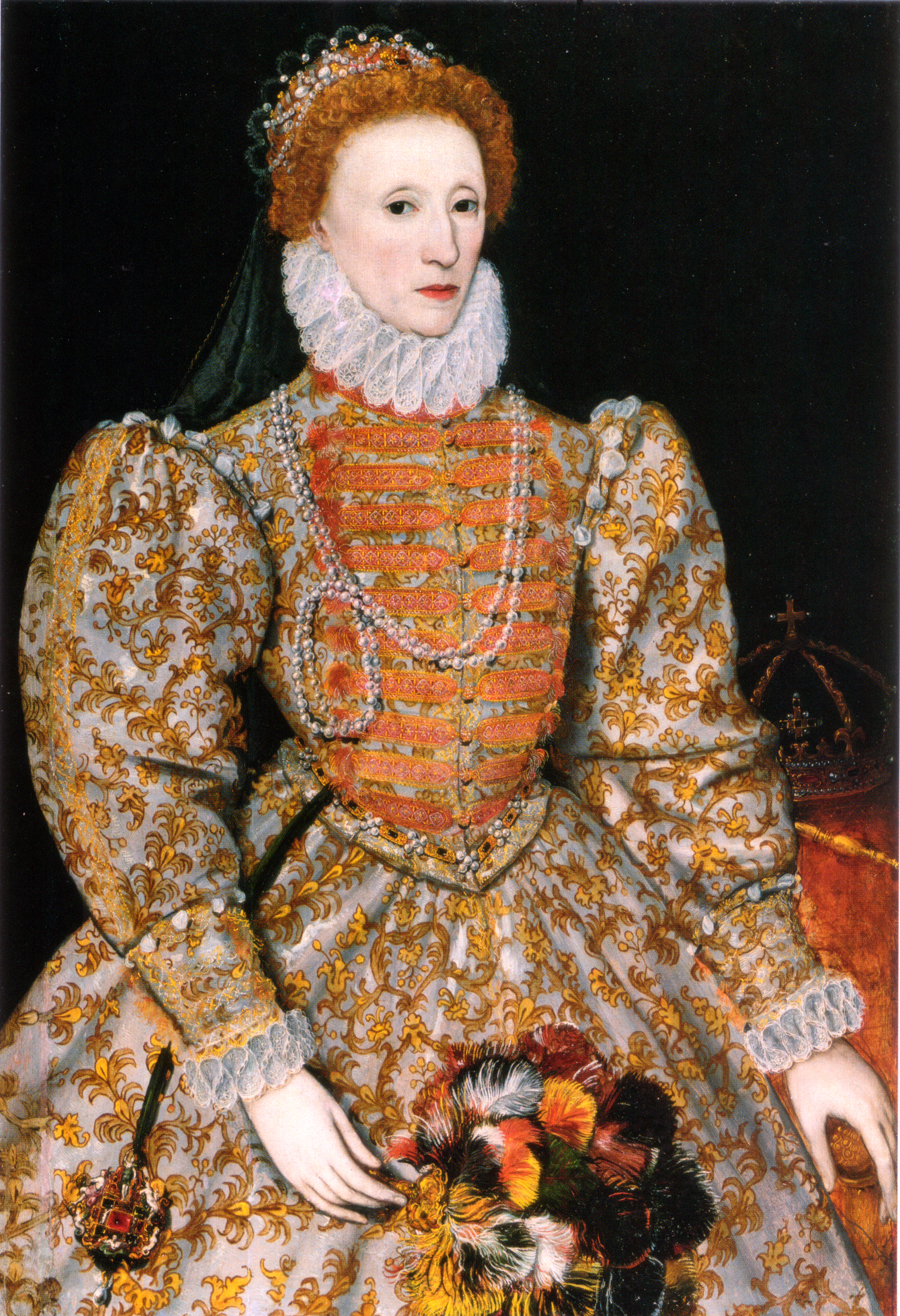
When Elizabeth I died on March 24, 1603, she was arguably the most carefully managed public figure in English history. For decades, she had controlled her image with extraordinary discipline, projecting a vision of herself as the Virgin Queen, almost divine, certainly untouchable.
What happened to her body after death was the opposite of all that.
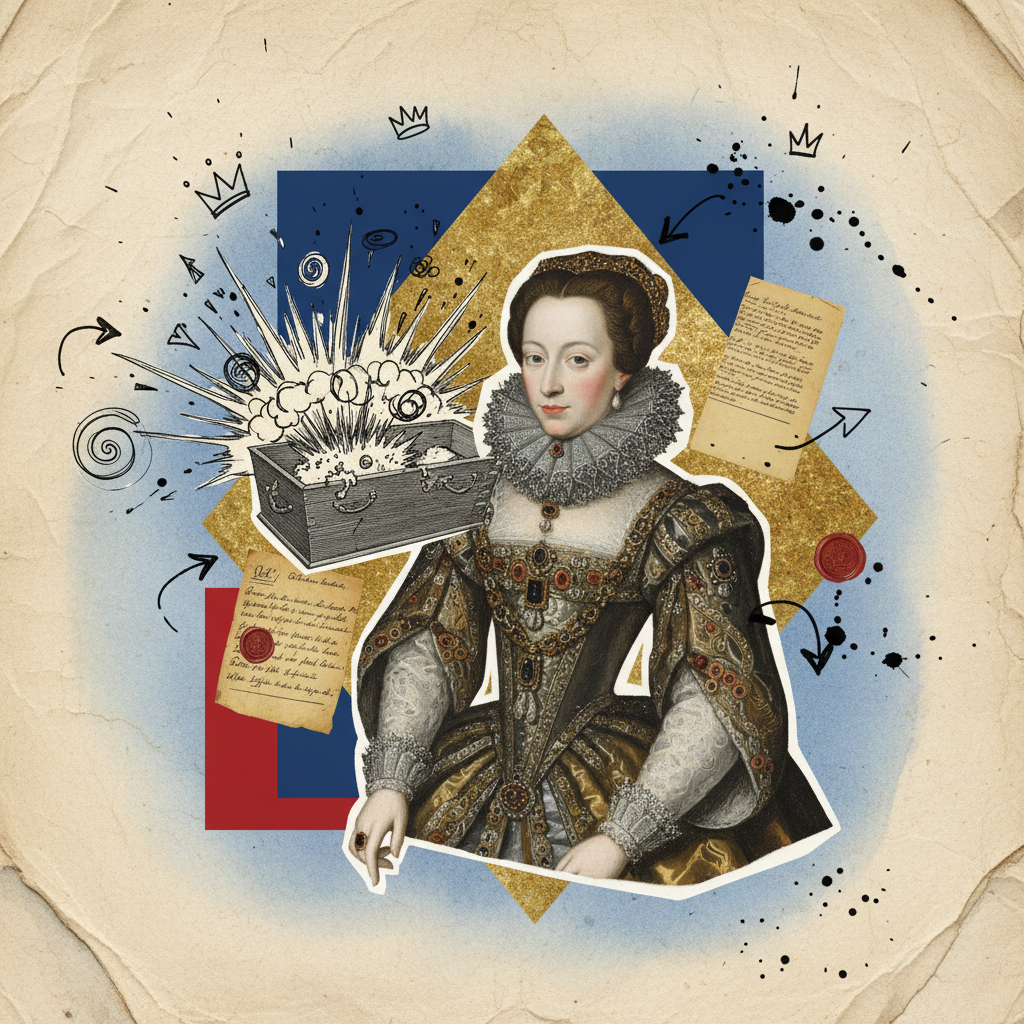
Her embalmed remains were sealed inside a lead coffin and left largely unattended at Richmond Palace while her courtiers rushed north to introduce themselves to her successor, James VI of Scotland. Then, according to a firsthand account written by Elizabeth Southwell, one of the Queen's Maids of Honour, the coffin cracked open with a loud bang at Whitehall. The cause, most historians believe, was gas buildup from a botched embalming job.
The woman who had stage-managed her own legend for half a century could not manage her own corpse.
Historical Background
Elizabeth I had ruled England for nearly 45 years when she died, aged 69, at Richmond Palace in Surrey. Her reign had been defined, in large part, by image. She wore elaborate white makeup to suggest timelessness. She commissioned portraits under strict guidelines. She gave carefully worded speeches that could be read multiple ways at once. Her virginity, real or not, was treated as a political instrument.
By 1603, though, the image had begun to crack even before her death. Those who saw her in her final months described a woman visibly aged, her teeth blackened, her hair thinning beneath her wigs. She had reportedly refused to eat properly for weeks before she died, and she spent her final days sitting on cushions on the floor, unwilling or unable to move to her bed.
Her death itself was quiet. Her death's aftermath was not.
What Happened
The Abandonment at Richmond
The moment Elizabeth died, the political center of gravity shifted. Her chief minister, Robert Cecil, had already been conducting secret correspondence with James VI of Scotland for months, preparing for the succession. Within hours of Elizabeth's death, a rider was galloping north to inform James that he was now King of England.
The rest of the court followed, in spirit if not immediately in body. The Queen's chambers were picked over. Her belongings were distributed or taken. The elaborate rituals that might have attended a monarch's death were compressed or skipped entirely.
Elizabeth's body was embalmed, as was customary, but the process appears to have been done poorly. Her remains were then placed in a lead-lined coffin and left at Richmond Palace for approximately ten days before being moved to Whitehall for the formal lying-in-state.
The Crack at Whitehall
What happened next comes primarily from a single source: a manuscript account attributed to Elizabeth Southwell, who had served as a Maid of Honour to the Queen. Southwell's account, written after she had converted to Catholicism and fled England, describes the coffin splitting open at Whitehall with a sound loud enough to alarm those nearby.
The most plausible explanation is straightforward: gases produced by decomposition built up inside the sealed lead coffin until the pressure became too great. Lead coffins, designed to be airtight, are particularly prone to this when embalming is incomplete or unsuccessful. It was not a rare occurrence in the era, but it was a deeply unfortunate one for a queen who had made dignity her lifelong project.
Southwell's account also includes more sensational claims, including supernatural omens surrounding Elizabeth's death, and historians treat these portions with appropriate skepticism. But the coffin rupture itself is considered credible, consistent with the known science of decomposition and the documented problems with her embalming.
The Funeral Delay
Elizabeth's funeral did not take place until April 28, 1603, more than a month after her death. Her effigy, a lifelike wax figure dressed in royal robes, was placed on top of the coffin for the procession, which wound through London to Westminster Abbey. Thousands of Londoners lined the streets. Many wept, or so the chroniclers tell us.
James I, notably, did not attend.
Why It Was Strange
The strangeness here is not simply physical. It is the collision between a life spent on meticulous self-presentation and a death that unraveled that presentation almost immediately.
Elizabeth had no legitimate heir, no husband, no children. Her court's only rational move after her death was to attach itself to the next source of power as quickly as possible. This is what courts do. But the speed with which they did it, leaving her body behind in a palace while they rode north, illustrates something uncomfortable about the nature of royal authority: it ends the moment the monarch does.
The coffin rupture, if it happened as Southwell described, is almost a dark punchline. The woman who had spent decades being portrayed as nearly supernatural was undone by ordinary biology.
There is also something worth noting about who preserved the story. Elizabeth Southwell was a Catholic convert writing from exile, with reasons to cast the Elizabethan court in an unflattering light. That does not make her account false, but it does mean it should be read carefully. History often survives because someone with a particular point of view decided to write something down.
Historical Legacy
Elizabeth I's reputation recovered, obviously. She became one of England's most celebrated monarchs, her reign recast as a golden age in the centuries after her death. The stories of her final weeks, including the state of her body, the abandoned palace, the cracked coffin, were largely set aside in favor of the grander narrative.
But they did not disappear. Historians and biographers have returned to Southwell's account repeatedly, using it as a window into the gap between royal mythology and royal reality.
The account also raises questions that remain relevant to how we think about powerful figures in general. The image Elizabeth projected was constructed, maintained, and ultimately fragile. The machinery of monarchy could produce an icon, but it could not, in the end, control what happened after the icon died.
Her funeral effigy, the wax figure that rode atop her coffin through the streets of London, is in some ways the perfect symbol of this. The crowd mourned a representation. The actual queen had been sealed in lead, badly embalmed, and left in an empty palace while her court moved on.
Elizabeth I had always understood, better than most, that the image was the power. In death, the image outlasted her by exactly one month and then rode to Westminster on a cart.
The body, as it turned out, had its own timeline.
Sources

Written by
The History, But Strange Team
We dig into the weirdest, strangest, and most forgotten corners of real history. From bizarre royal scandals to unusual medical practices and darkly funny disasters, our team researches and writes about the stories your textbooks left out.