June 19, 2026· 6 min read
The Queen Who Ruled With Her Hands: Elizabeth I's Strangest Obsession
Foreign ambassadors noticed it. Portrait painters captured it. Queen Elizabeth I's fixation with her hands was one of the most deliberate image campaigns in royal history.
Historical Figures

Strange Fact
Queen Elizabeth I had a habit of pulling off her gloves during diplomatic meetings, not out of restlessness, but on purpose. She would gesture and fidget in ways that kept her hands in full view, drawing the eyes of ambassadors, courtiers, and foreign dignitaries toward her fingers.
She also commissioned gloves with extended finger gussets, exaggerated panels of fabric that made her already long fingers appear even more slender and refined. Her hands were not an afterthought. They were a political instrument.
Historical Background
Elizabeth I reigned over England from 1558 to 1603, a period of intense political pressure, religious conflict, and personal scrutiny. As an unmarried female monarch in a world built around male authority, she operated under constant observation. Every aspect of her appearance carried weight.
The late Renaissance placed enormous symbolic value on physical features as markers of social rank. Long, slender fingers and delicate wrists were considered signs of noble birth, refinement, and elevated character. This was not mere superstition; it was a widely shared cultural belief that the body reflected the quality of one's lineage.
For Elizabeth, who needed to project legitimate, unquestionable authority, the body was never simply a body. It was a text, and she controlled what it said.
What Happened
The Hands as a Royal Statement
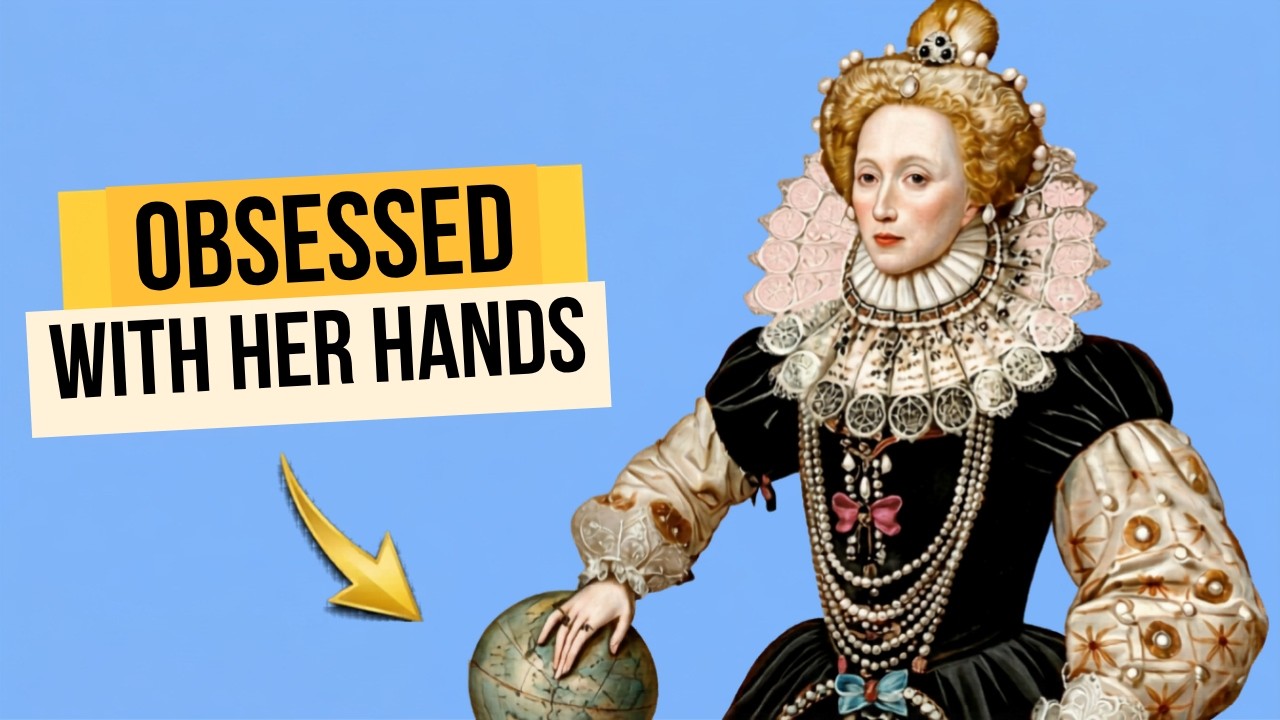
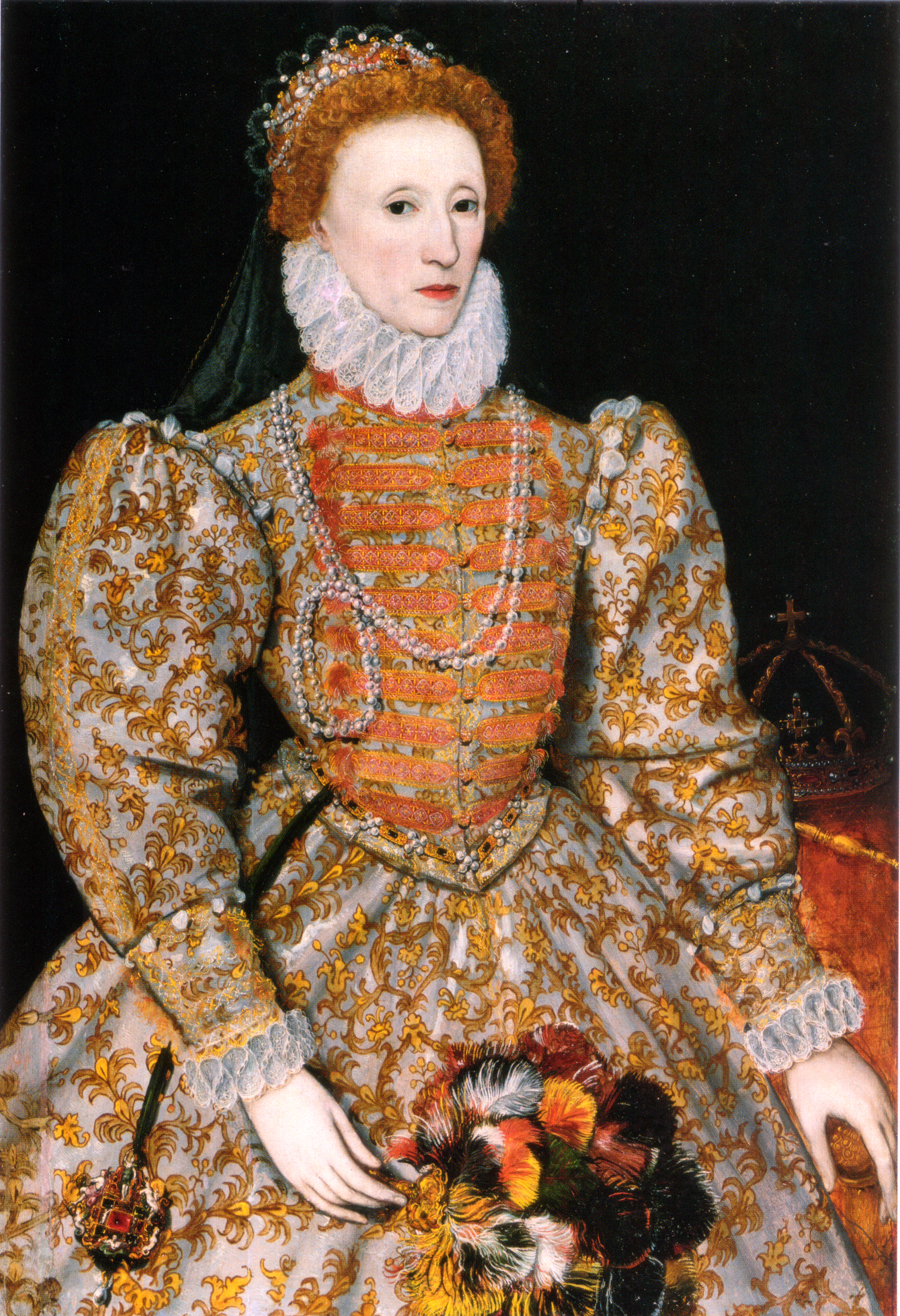
Contemporary accounts from foreign ambassadors and courtiers frequently noted Elizabeth's hands. She was described as possessing unusually long, elegant fingers, a feature she clearly knew about and cultivated. Portraits from throughout her reign consistently emphasize her hands, often positioning them front and center in the composition.
She wore gloves as a standard part of court dress, as most noblewomen did. But Elizabeth took this further. The custom-made gloves she commissioned were designed to elongate the appearance of her fingers, and she treated the act of removing them almost as a performance. Pulling off a glove in public, slowly and deliberately, was a way of saying: look here.
A Possible Second Motive
Elizabeth survived a bout of smallpox in 1562, at the age of twenty-nine. The illness left lasting marks on her skin, and while her face bore the more visible damage, the psychological impact was significant. The famous white lead makeup she applied throughout the later years of her reign served partly to mask the scarring on her complexion.
Some historians suggest her emphasis on her hands may have served a similar purpose, redirecting attention toward a feature she was confident in and away from those she was not. Whether this was a conscious strategy or simply a natural response to her own self-image, the effect was the same. Observers left her presence talking about her hands.
The Portraits Tell the Story
Look at almost any formal portrait of Elizabeth and her hands are prominent. The Armada Portrait (c. 1588), one of the most recognizable images of her reign, shows her right hand resting on a globe, fingers spread, commanding and deliberate. The Ditchley Portrait (c. 1592) places her hands in a similarly composed position. These were not accidents. Portrait sittings were highly managed affairs, and Elizabeth was known to be a demanding subject.
The painters were following her lead.
Why It Was Strange
Royal image management is nothing new. What makes Elizabeth's case unusual is how granular and physical it was.
Most monarchs controlled their image through grand gestures: military displays, architectural projects, religious ceremonies, and the careful staging of public appearances. Elizabeth did all of that too. But she also worked at the level of finger length and glove design. She managed her image down to the anatomy.
There is also something striking about the gap between the mythology of Elizabeth, the imperious Virgin Queen, fearless and untouchable, and the reality of a woman carefully engineering which parts of her body people paid attention to. The obsession with her hands reveals an anxiety beneath the armor, a very human awareness of how she was being seen and judged.
At the same time, it reveals genuine sophistication. She understood something that modern publicists understand: you cannot control everything people think, but you can control where they look.
- She redirected attention through deliberate gesture and movement
- She used fashion and tailoring to physically alter perception
- She ensured painters reinforced the same visual message
- She turned a personal vanity into a coherent, consistent piece of political theater
That is not strange in the pejorative sense. It is strange in the sense of being unexpectedly precise, unexpectedly modern, and unexpectedly revealing about how power actually works.
Historical Legacy
Elizabeth I remains one of the most studied monarchs in British history, and rightly so. Her political instincts, her management of Parliament, her navigation of the Protestant Reformation, and her handling of threats both foreign and domestic have kept historians busy for centuries.
But the story of her hands is a useful corrective to the tendency to treat great rulers as figures above ordinary human concern. Elizabeth was deeply aware of her body, her appearance, and how both were perceived. She worked on these things the way a modern politician works on messaging.
The gloves, the gestures, the portraits: they remind us that image and substance are rarely as separate as we like to think. Elizabeth's power was real, but it was also constructed, maintained, and performed. Her hands were one of the tools she used to build it.
There is also a broader point about the period. The Renaissance court was a visual culture. Clothing, bearing, gesture, and physical appearance were all read as signs of character, rank, and intention. Elizabeth was a product of that culture. She simply played the game better than most.
Her reign lasted forty-five years. When she died in 1603, she left behind no direct heir, but she did leave behind one of the most carefully constructed royal images in English history. Every brushstroke, every glove seam, every deliberate removal of a glove in front of a watching ambassador, was part of that construction.
It was, in the end, a remarkably effective strategy. We are still looking at her hands.
Sources
- Hilton, Lisa. Elizabeth: Renaissance Prince. Houghton Mifflin Harcourt, 2015.
- Starkey, David. Elizabeth: The Struggle for the Throne. HarperCollins, 2001.
- Frye, Susan. "The Myth of Elizabeth at Tilbury." The Sixteenth Century Journal, vol. 23, no. 1, 1992. https://www.jstor.org/stable/2542066
- National Portrait Gallery, London. "The Armada Portrait of Queen Elizabeth I." https://www.npg.org.uk
- Weir, Alison. The Life of Elizabeth I. Ballantine Books, 1998.
- Guy, John. Queen of Scots: The True Life of Mary Stuart. Houghton Mifflin, 2004. (Context on Tudor court culture and rival royal image-making.)
- Hackett, Helen. Virgin Mother, Maiden Queen: Elizabeth I and the Cult of the Virgin Mary. Palgrave Macmillan, 1995.

Written by
The History, But Strange Team
We dig into the weirdest, strangest, and most forgotten corners of real history. From bizarre royal scandals to unusual medical practices and darkly funny disasters, our team researches and writes about the stories your textbooks left out.