June 27, 2026· 7 min read
The Queen Who Almost Wasn't: How Catherine Parr Talked Her Way Out of a Royal Death Warrant
In the summer of 1546, Henry VIII signed an arrest warrant for his own wife — and Catherine Parr saved her life with a single, perfectly timed conversation.
Strange Fact
History remembers Catherine Parr as the queen who survived Henry VIII. She is often the reassuring punchline to the grim rhyme about his six wives: divorced, beheaded, died, divorced, beheaded, survived. But that tidy narrative conceals something far more unsettling.
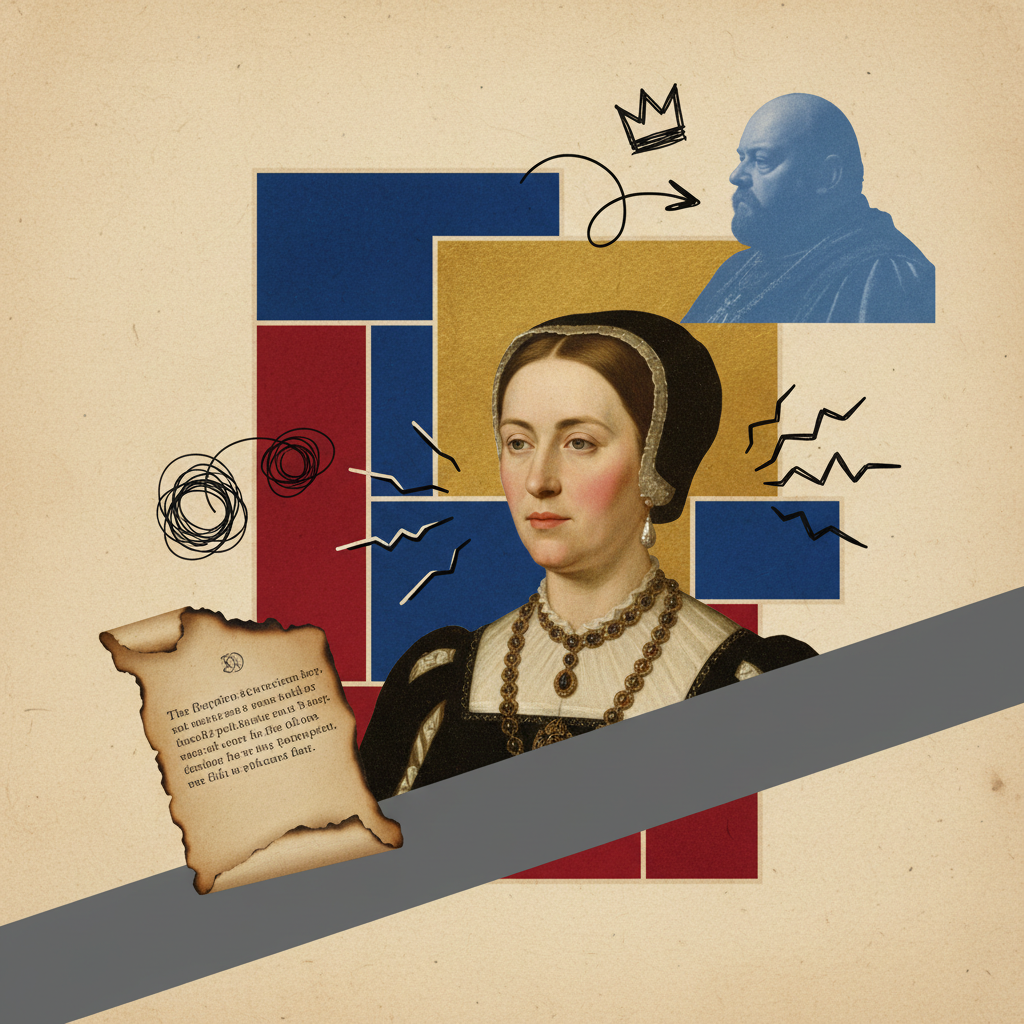
In the summer of 1546, Henry VIII signed an arrest warrant for Catherine Parr, his sixth and final wife. The charge was heresy. The likely outcome, had the arrest proceeded, was execution.
She found out by accident. And she saved her own life by reframing months of theological debate as an act of wifely flattery — in real time, to the man who had just authorized her arrest.
The chancellor arrived the next day to take her into custody. Henry sent him away in fury.
Historical Background
By 1546, Henry VIII was a shadow of the vigorous king he had once been. He was 54, massively overweight, and tormented by a chronic leg wound that some historians believe had become seriously infected. He was in near-constant pain, frequently bedridden, and prone to violent mood swings.
He was also, despite everything, still politically dangerous. The court around him had calcified into two competing factions: a reformist Protestant faction, loosely aligned with Archbishop Thomas Cranmer, and a conservative Catholic faction led by figures like Stephen Gardiner, Bishop of Winchester, and Thomas Wriothesley, the Lord Chancellor.
Catherine Parr had made no secret of her Protestant sympathies. She was one of the most educated women in England, fluent in Latin, French, and Italian, and she had authored or co-authored devotional works that reflected the new reformist thinking sweeping through Europe. She held theological discussions at court, encouraged the education of Henry's children in humanist and Protestant traditions, and had even engaged Henry himself in religious debate.
To the conservative faction, she was a target worth pursuing. And by mid-1546, they had found their opening.
What Happened
The precise details of the plot against Catherine come primarily from John Foxe's Acts and Monuments, published in 1563, which drew on accounts from people close to the events. Foxe had clear Protestant sympathies, and historians treat his account with appropriate caution, but the broad outline is widely accepted.
Gardiner and Wriothesley, watching Catherine's influence over Henry with growing alarm, began building a case against her on grounds of heresy. Henry's religious settlement was a particular and unstable thing: he had broken with Rome, but he had not become a Protestant. The Six Articles of 1539 had actually reaffirmed several Catholic doctrines and made denial of transubstantiation a capital offence. Catherine's views, if pushed far enough, could be framed as dangerous.
The conservative courtiers presented their case to Henry and, in a moment that must have seemed unthinkable to those who knew her position, he signed the arrest warrant.
What happened next depends on which account you follow. According to Foxe, a copy of the warrant was dropped in a palace corridor and found by someone sympathetic to Catherine, who brought it to her. She was reportedly so distressed that her cries of anguish could be heard by Henry, who sent his own physicians to attend to her.
Once she had steadied herself, Catherine did something that required either extraordinary nerve or extraordinary desperation. She went to Henry.
The Conversation That Saved Her Life
The exchange that followed was, by any measure, a remarkable performance. Catherine did not argue her innocence. She did not appeal to Henry's affection. Instead, she effectively told him that she had never meant to hold opinions of her own at all.
Her position, as she presented it to Henry, was this: she had raised theological questions not because she held independent views, but because she had hoped the discussion would distract him from his pain, and because she had hoped to benefit from his superior knowledge. She was not debating him. She had been learning from him.
Henry, according to Foxe, accepted this entirely. "And is it even so, sweetheart?" he reportedly said. "Then perfect friends we are now again."
The following day, Wriothesley arrived at the palace with a party of guards to take Catherine and several of her ladies into custody. Henry confronted him personally and, in front of witnesses, berated him as "a knave, arrant knave, beast, and fool." The arrest was abandoned.
Why It Was Strange
The strangeness here is not merely that Catherine was nearly executed. Henry had, after all, executed two wives before her. The strangeness lies in the specific mechanics of what happened.
The man who signed the warrant and the man she talked out of it were the same man. Henry did not simply pardon Catherine after learning she was innocent. He had authorized the arrest himself, presumably in a moment when the conservative faction had successfully framed her views as dangerous. What Catherine did was not clear her name but change the frame entirely, and do it fast enough that Henry turned on the chancellor he had personally empowered.
There is also something worth sitting with in Catherine's chosen strategy. She was one of the most intellectually formidable women of her age. Her published devotional writing — including Prayers or Meditations (1545), the first book published in English under a queen consort's name — showed genuine theological engagement. And yet, to survive, she told the most powerful man in England that she had never had a thought of her own.
It worked. Whether she believed a word of it is another question entirely.
The episode also reveals something about the fragility of royal favor in the Tudor court. Catherine had been Henry's wife for three years. She had helped manage the kingdom during his military campaigns in France. She had a genuine relationship with his children, particularly the future Elizabeth I. And none of that insulated her from a signed warrant for her arrest. The margin between queen and prisoner, in Henry's court, could close with frightening speed.
Historical Legacy
Catherine Parr outlived Henry VIII by only eighteen months. He died in January 1547, and she quickly married her earlier love, Thomas Seymour, uncle to the young Edward VI. She died in September 1548, shortly after giving birth to her only child, a daughter named Mary.
She never faced another moment quite like the summer of 1546. But the episode left a mark on how she has been understood ever since.
For centuries, the near-arrest was treated as a footnote, a dramatic flourish in the story of the wife who survived. More recently, historians including Susan James and David Starkey have given it more weight, reading it as evidence of how seriously the conservative faction viewed Catherine's religious influence, and how close the Henrician Reformation came to devouring one of its own most prominent female voices.
Catherine's intellectual legacy has also been reassessed. Her devotional works circulated widely after her death and influenced Protestant piety in England for decades. The woman who told Henry she had no opinions of her own had, in fact, published those opinions for anyone in England to read.
The survival narrative, it turns out, is more complicated than the rhyme suggests. Catherine did not simply outlast Henry. At a critical moment, she out-maneuvered him — and she did it by making him believe she had never tried.
Sources

Written by
The History, But Strange Team
We dig into the weirdest, strangest, and most forgotten corners of real history. From bizarre royal scandals to unusual medical practices and darkly funny disasters, our team researches and writes about the stories your textbooks left out.