June 19, 2026· 7 min read
The Iron Cage That Silenced Women: The History of the Scold's Bridle
In 16th and 17th century Europe, women who spoke too freely risked being fitted with an iron cage designed to make speech physically impossible.

Strange Fact
In early modern England and Scotland, a woman could be led through the streets of her own town wearing an iron cage bolted around her head, with a metal plate pressed against her tongue. She had committed no violent crime. In many cases, she had simply argued with a neighbor, spoken back to her husband, or repeated gossip in the market square.
The device was called the scold's bridle, also known as the branks. It was not a product of medieval torture chambers or wartime cruelty. It was a civic punishment, administered by local authorities, often in broad daylight, in front of an audience.
That detail is worth sitting with. This was not a secret atrocity. It was a public event.
Historical Background
The 16th and 17th centuries in Europe were a period of intense anxiety about social order. Religious reformations, economic upheaval, and shifting political structures made communities deeply concerned with hierarchy and conformity. Within that context, the role of women was rigidly defined.
Women were expected to be subordinate to their husbands and, by extension, to male authority in general. A woman who spoke out of turn, who argued publicly, or who was perceived as quarrelsome or domineering was given a specific legal label: a scold.
Under English common law, scolding was a recognized offense. It referred to a woman whose speech was considered a public nuisance, someone who disturbed the peace of the community through persistent arguing, nagging, or gossip. The law did not apply to men in the same way. A man who argued loudly was assertive. A woman who did the same was a criminal.
Punishments for scolding varied. The ducking stool, which involved strapping a woman to a chair and repeatedly submerging her in water, was one common method. But the scold's bridle offered something the ducking stool did not: it could be worn for extended periods, turning the punishment into a prolonged, ambulatory spectacle.
What Happened
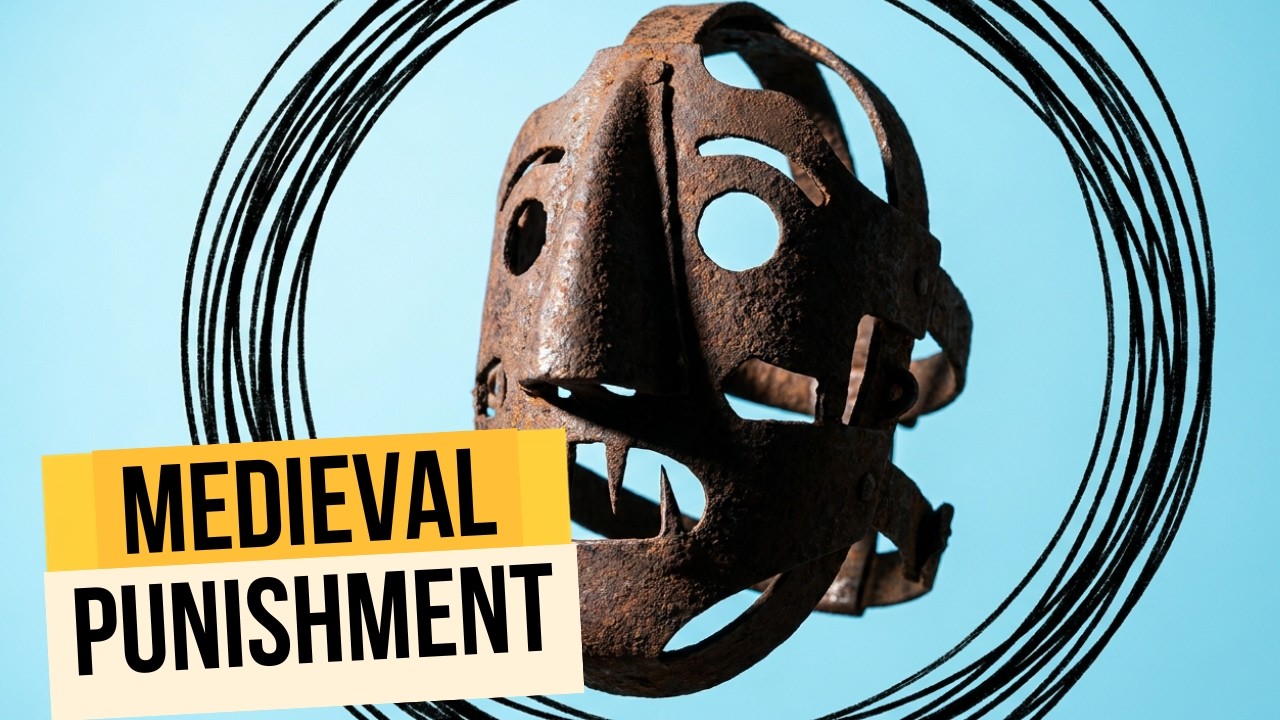
The scold's bridle was an iron framework, roughly shaped to fit over a human head. It locked at the back or sides, enclosing the skull like a cage. At the front, projecting inward toward the mouth, was a flat or spiked metal plate designed to rest on the tongue.
Some versions were relatively smooth. Others had spikes or rough edges on the plate, ensuring that any attempt to move the tongue caused pain. The wearer could not speak, could barely swallow, and had almost no ability to communicate beyond facial expression.
Once fitted, a woman might be led through town on a chain or leash, typically held by a local official or even her own husband. The walk served a dual purpose. It physically restrained her voice, and it made her an object of public ridicule, inviting bystanders to jeer, mock, or throw things.
The duration varied. Some women wore the device for an hour. Others remained in it for much of the day. Records from Scottish burghs show that the branks was sometimes used as a precursor to further punishment, worn while a woman awaited additional sentencing.
Who Was Targeted?
The women subjected to the bridle were rarely from positions of wealth or influence. Court and parish records from England and Scotland suggest the punishment fell most heavily on:
- Women involved in neighborhood disputes, particularly arguments with other women
- Wives accused by their husbands of persistent disobedience or verbal aggression
- Women who challenged authority figures, including clergymen or local magistrates
- Those labeled as gossips, a term that carried far more legal weight then than it does today
The device appears in surviving records from the late 16th century onward, with documented use continuing into the 18th century in some parts of Britain. A number of original branks survive in museum collections across England and Scotland, some still displayed in the towns where they were used.
Why It Was Strange
What makes the scold's bridle historically remarkable is not simply its brutality. Medieval and early modern Europe had no shortage of brutal punishments. What sets it apart is its specificity.
It was engineered for one purpose: silencing speech. Not restraining movement, not inflicting pain as a deterrent for violent crime, but physically preventing a woman from using her voice. The punishment was, in its design, an admission of what those in power actually feared.
There is also something telling in the theatrical dimension of the punishment. The bridle was not administered in private. It was a performance. The woman wearing it was meant to be seen, and the community watching was meant to draw conclusions about what happened to women who forgot their place.
The scold's bridle also sits uncomfortably alongside the broader witch trial era. Many women accused of witchcraft were similarly charged with using their words improperly, through cursing, prophesying, or simply speaking in ways that made their neighbors uneasy. The line between a scold and a witch was often a matter of degree and local politics rather than evidence.
Perhaps most strangely, the bridle was sometimes treated as a household object. In some Scottish records, husbands requested access to the town's branks to use on their wives at home. The device, designed and maintained by civic authorities, was on occasion loaned out like a piece of community equipment.
Historical Legacy
The scold's bridle fell out of formal legal use in Britain during the 18th century, as attitudes toward public punishment gradually shifted and the specific legal category of scolding was increasingly viewed as archaic. The last documented uses appear to date from the early 1800s, though by then they were already considered relics of an older, harsher era.
Several original bridles survive today. The Morpeth Chantry Bagpipe Museum in Northumberland holds one. Others are kept in local history collections in Walton-on-Thames, Chester, and various Scottish burghs. They are displayed as artifacts, but their physical presence is unusually direct. They are small, human-sized, and clearly built to fit on a person's head. Looking at one in a glass case makes their history difficult to abstract.
For historians, the scold's bridle raises questions that extend well beyond its own era. It illustrates how legal systems can encode social anxieties about gender and power into physical objects. It shows how the language of public order and community peace can be deployed to suppress rather than protect.
It also serves as a reminder that the suppression of women's speech was not always covert or shameful to those who practiced it. It was, for a period, simply how things worked. That is perhaps the most unsettling fact of all.
Sources
-
Boose, Lynda E. "Scolding Brides and Bridling Scolds: Taming the Woman's Unruly Member." Shakespeare Quarterly, vol. 42, no. 2, 1991, pp. 179–213. https://doi.org/10.2307/2870584
-
Underdown, D. E. "The Taming of the Scold: The Enforcement of Patriarchal Authority in Early Modern England." Order and Disorder in Early Modern England, edited by Anthony Fletcher and John Stevenson, Cambridge University Press, 1985.
-
Sharpe, J. A. Crime in Early Modern England 1550–1750. Longman, 1984.
-
Walker, Garthine. Crime, Gender and Social Order in Early Modern England. Cambridge University Press, 2003. https://www.cambridge.org/9780521576536
-
Museum of London Collections: Scold's Bridle artifact records. https://www.museumoflondon.org.uk
-
Historic England: Listed descriptions of surviving branks in English collections. https://historicengland.org.uk
-
Ingram, Martin. "Scolding Women Cucked or Washed: A Crisis in Gender Relations in Early Modern England?" Women, Crime and the Courts in Early Modern England, edited by Jenny Kermode and Garthine Walker, UCL Press, 1994.

Written by
The History, But Strange Team
We dig into the weirdest, strangest, and most forgotten corners of real history. From bizarre royal scandals to unusual medical practices and darkly funny disasters, our team researches and writes about the stories your textbooks left out.