June 19, 2026· 6 min read
The Women Who Wore Giant Black Circles on Their Faces — and What It Really Meant
In 18th-century colonial Mexico, fashionable women glued large black discs to their temples — a trend that began as a headache remedy and became a silent language of courtship.

Strange Fact
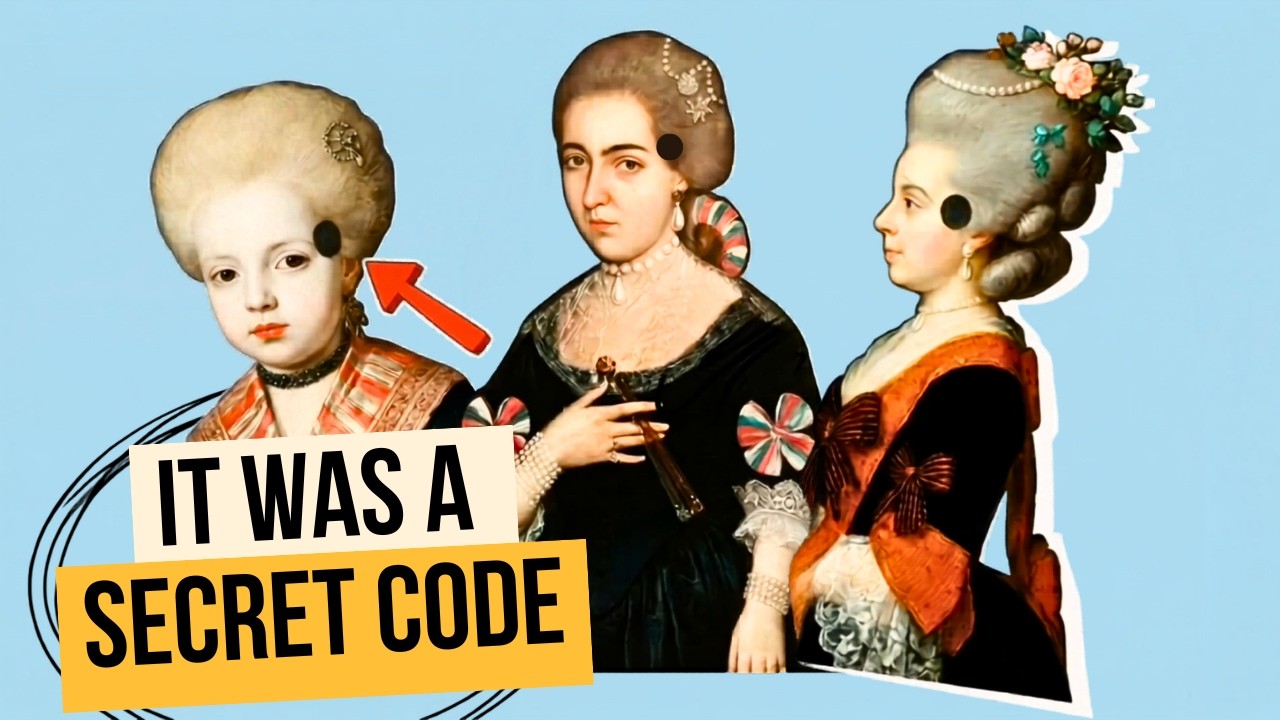
At the height of colonial Mexican society, wealthy women in New Spain sometimes appeared in public with one or two large, black circular patches pressed firmly against their temples. These were not wounds, not mourning symbols, and not cosmetic mistakes. They were chiqueadores: carefully placed beauty accessories that signaled, to those who knew how to read them, everything from social status to romantic availability.
Few fashion trends in history have carried so much meaning in so small an object.
Historical Background
The 18th century in New Spain (the colonial territory that encompassed present-day Mexico) was a period of extraordinary cultural complexity. Spanish colonial rule had created a layered society in which European customs, Indigenous traditions, and new hybrid identities constantly collided and blended.
For the elite criollo class — people of Spanish descent born in the Americas — maintaining a connection to European fashion was not merely a matter of taste. It was a declaration of identity and social standing. Letters, trade goods, and portraits crossed the Atlantic, carrying the latest fashions from Madrid, Paris, and Versailles into the salons of Mexico City.
Beauty patches were already well established in European courts by this time. Small adhesive shapes made from black silk, velvet, or taffeta had been fashionable across Europe since at least the 17th century. They appeared in portraits of aristocrats and were considered marks of refinement. By the early 18th century, the tradition had spread and evolved, and New Spain developed its own variation.
The chiqueador was distinctive from its European cousins primarily in its size and placement. Rather than small decorative shapes scattered across the face, chiqueadores were notably large, round, and placed specifically at the temples.
What Happened
From Medicine to Fashion
The earliest references to chiqueadores suggest a practical, medical origin. Temple pain — headaches and migraines — was a well-documented complaint in colonial-era medical texts, and circular patches applied to the temples were believed to provide relief. The material, likely a type of adhesive poultice or medicated patch, was thought to draw out pain or provide a cooling, soothing pressure.
This kind of medicinal beauty accessory was not unusual for the period. Throughout history, the line between medicine and adornment has frequently blurred. What began as a remedy was, over time, absorbed into the visual language of fashion.
By the mid-18th century, chiqueadores had shed most of their purely medicinal associations. They were now fashion objects, worn not because a woman had a headache, but because wearing them was elegant. The patch had become the point.
The Influence of European Royalty
One significant driver of the chiqueador's rise in fashionable circles was the influence of European royal portraiture. Queen Maria Luisa of Parma, who became Queen of Spain as the wife of Charles IV, was among the figures whose style was closely watched and imitated by the colonial elite. Her image circulated through portraits, and Mexican high society absorbed these visual cues with enthusiasm.
The women of New Spain were not simply copying European trends passively. They were adapting them, making them larger, bolder, and in the case of chiqueadores, assigning them new layers of social meaning that went far beyond anything happening in European courts.
A Secret Language of Love
Perhaps the most intriguing aspect of chiqueadores is what an 18th-century courtship guide reportedly described as their communicative function. According to this source, the placement of a patch could signal a woman's romantic status:
- A patch on one side of the face indicated that her heart was already spoken for.
- A patch on the opposite side suggested she was open to courtship.
Whether this code was widely understood, actively practiced, or simply an idealized description in a conduct manual is difficult to confirm with certainty. But the idea itself reveals something important: in the highly structured social world of colonial Mexico's elite, public appearances were governed by layers of meaning. A woman's clothing, jewelry, comportment, and yes, her beauty patches, were all legible to an informed observer.
Social gatherings in colonial Mexico City's salons were not casual affairs. They were performances, in which every detail of a person's appearance carried potential significance. The chiqueador, in this context, was less a decoration than a statement.
Why It Was Strange
From a modern perspective, chiqueadores look startling. A large, perfectly round black disc pressed against the temple is not something we associate with beauty. But strangeness in fashion is almost always a product of context. What looks bizarre in one era is simply correct in another.
What makes chiqueadores genuinely unusual, even by historical standards, is the combination of things they were expected to do simultaneously:
- Relieve physical pain (their original function)
- Signal wealth and social refinement (their fashionable function)
- Communicate romantic availability (their social function)
Very few accessories in history have been asked to carry that much weight at once. The chiqueador was medicine, status symbol, and personal advertisement — all in a circle of black fabric smaller than a playing card.
There is also something quietly radical about the courtship code dimension. In a society where women's romantic choices were heavily constrained by family arrangements and social propriety, a system of subtle visual signals worn on the body represents a small, private assertion of agency. Whether or not every woman who wore a chiqueador intended to send a message, the possibility of the message was there.
Historical Legacy
Chiqueadores largely disappeared as the 19th century arrived and colonial society transformed. Mexican independence in 1821 brought new cultural currents, and the fashions of New Spain's criollo elite gave way to different influences and different preoccupations.
But chiqueadores remain visible in the historical record, most notably in colonial-era portraits. These paintings, which depict wealthy Mexican women in elaborate dress, occasionally show the distinctive black temple patches with matter-of-fact clarity. To contemporary viewers, the patches leap out as strange. To the women in the paintings, they were simply part of being dressed.
Today, chiqueadores are most often discussed in the context of colonial Mexican material culture and the history of beauty. They offer historians a small but surprisingly rich window into how fashion, medicine, and social communication overlapped in 18th-century New Spain.
They also serve as a reminder of something easy to forget: that the people of the past were not simpler or less sophisticated than we are. They were navigating complex social worlds with their own codes and systems, some of which were stitched onto their faces for everyone to see — if they knew how to look.
Sources
- Katzew, Ilona. Casta Painting: Images of Race in Eighteenth-Century Mexico. Yale University Press, 2004.
- Earle, Rebecca. The Body of the Conquistador: Food, Race and the Colonial Experience in Spanish America, 1492–1700. Cambridge University Press, 2012.
- Martínez, María Elena. Genealogical Fictions: Limpieza de Sangre, Religion, and Gender in Colonial Mexico. Stanford University Press, 2008.
- Museo Nacional de Historia, Mexico City — Colonial portraiture collections. https://mnh.inah.gob.mx
- Schell, Patience A. "Fashion and Identity in Colonial Mexico." Colonial Latin American Review, various issues. https://www.tandfonline.com/journals/ccla20
- Real Academia de la Historia (Spain) — 18th-century Spanish colonial records. https://www.rah.es

Written by
The History, But Strange Team
We dig into the weirdest, strangest, and most forgotten corners of real history. From bizarre royal scandals to unusual medical practices and darkly funny disasters, our team researches and writes about the stories your textbooks left out.