June 19, 2026· 6 min read
The Painful Price of a High Forehead: Medieval Beauty's Strangest Obsession
In the medieval and early Renaissance periods, noblewomen endured shaving, plucking, and caustic chemicals to push back their hairlines — all in pursuit of a beauty ideal that equated a bare forehead with refinement and intelligence.

Strange Fact
In the 14th and 15th centuries, some European noblewomen applied mixtures containing quicklime, arsenic, and vinegar directly to their scalps. The purpose was not medical. It was cosmetic. They were trying to stop their hair from growing back.
This was not an isolated fringe practice. It was documented in household manuals and beauty guides of the period, recommended alongside other grooming advice as though it were entirely routine.
The goal behind all of it was a single, striking feature: an extremely high, smooth, and domed forehead.
Historical Background
To understand why medieval women went to such lengths, it helps to understand what a high forehead meant in the cultural imagination of the time.
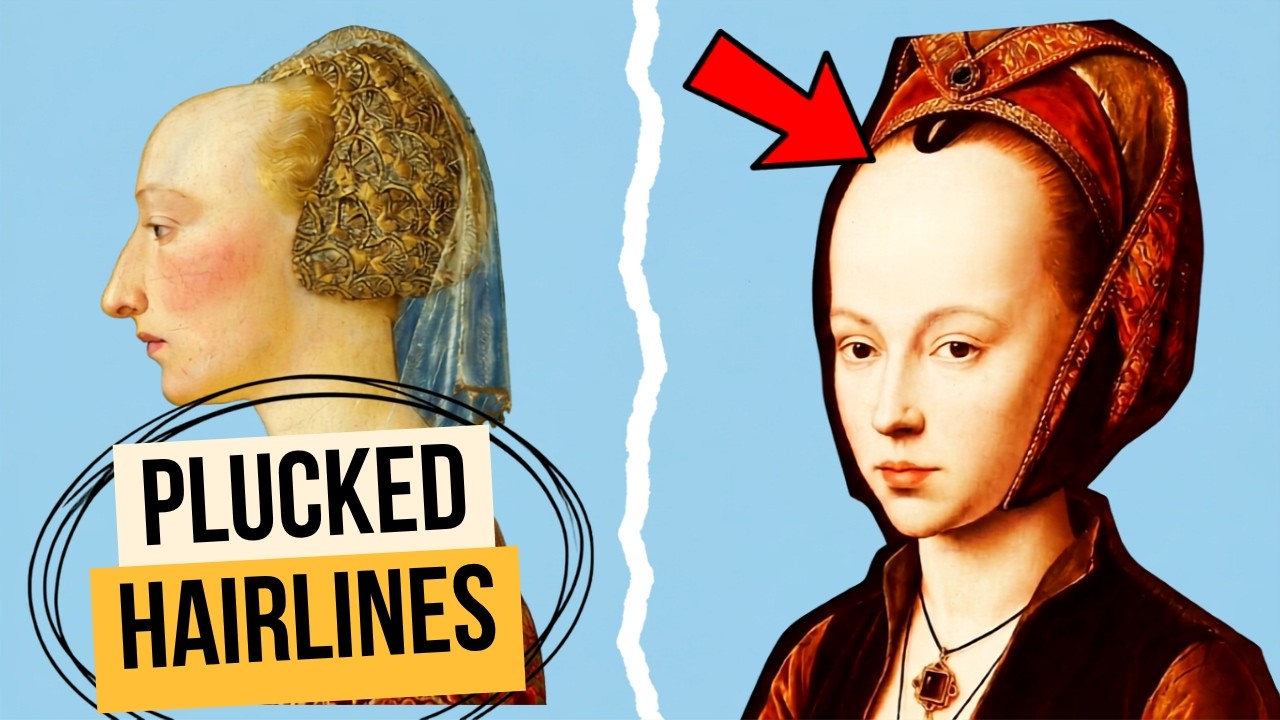
During the late medieval and early Renaissance periods, roughly from the 13th through the 15th centuries, a broad, unobstructed forehead was considered one of the clearest markers of feminine beauty, nobility, and intelligence. Portraits of aristocratic women from this era — Flemish panel paintings, French manuscript illuminations, Italian frescoes — consistently depict subjects with hairlines that sit remarkably far back on the skull, often accompanied by completely bare brows.
This was not an artistic convention invented by painters. It reflected a real aesthetic that real women were expected to embody.
The ideal was particularly prominent among the upper classes, where appearance was inseparable from social standing. A high forehead communicated that a woman was refined, educated, and well-born. It was, in a sense, worn as a credential.
Men were not immune to the trend either. Some historical sources suggest that fashionable men of the period also maintained high hairlines, though the pressure fell most heavily on women.
What Happened
Achieving the look required effort, and often, considerable pain.
Shaving and Plucking
The most straightforward method was shaving the hairline back, but many women went further. Contemporary accounts and beauty manuals describe the practice of plucking hairs individually from the hairline, follicle by follicle, to push the hairline further up the scalp. The process was slow, repetitive, and painful, but it produced a cleaner result than shaving alone, which left visible stubble.
Eyebrows were removed entirely by the same method. This gave the face a particular quality visible in surviving portraits: an open, almost unreadable blankness across the upper face that, to modern eyes, can seem unsettling. At the time, it was considered elegant.
Chemical Treatments
For women seeking more permanent results, medieval beauty guides offered recipes for depilatory preparations. These mixtures typically combined quicklime (calcium oxide), arsenic compounds, and acidic ingredients such as vinegar. Applied to the scalp, they were designed to destroy the hair at the root and, ideally, prevent regrowth.
The risks were significant. Quicklime reacts with moisture to generate heat and can cause chemical burns. Arsenic is toxic, capable of being absorbed through the skin. Women using these preparations on their scalps were, whether they understood it or not, exposing themselves to genuinely dangerous substances.
There is no reason to think these risks were entirely hidden. Caustic materials were understood to be caustic. The choice to use them anyway says something about the intensity of the social pressure involved.
Heat and Burning Instruments
Some sources describe yet another method: the application of heated metal objects directly to the scalp. Hot pins, or in some accounts, heated coins pressed against the skin, were used with the intention of cauterizing hair follicles and preventing future growth.
This was, in effect, a form of scarification performed for cosmetic purposes. The pain would have been immediate and severe. The long-term effectiveness is doubtful, though the scarring produced may well have served the purpose in some cases.
The Role of Headdresses
It is worth noting that the high-forehead ideal did not exist in isolation. The elaborate headdresses fashionable among noblewomen of the period, including the towering hennin (the tall conical hat) and the heart-shaped or horned styles common in Burgundian and English courts, were designed to be worn on a head with minimal visible hair at the front. The headdress and the bare forehead worked together as a unified aesthetic statement.
This means the hairline treatments were, in part, practical preparation for wearing these structures correctly. Fashion and pain were, as they so often are, deeply intertwined.
Why It Was Strange
What makes this practice genuinely striking, beyond the obvious physical discomfort, is the gap between the ideal being pursued and the methods used to pursue it.
The high forehead was associated with intellect and refinement. It was meant to signal that a woman was above coarse, ordinary existence. Yet the methods used to achieve it involved burning, chemical damage, and the systematic destruction of living tissue. The pursuit of an image of elevated humanity required something quite brutal in practice.
There is also the question of who bore the risk. The caustic mixtures described in medieval beauty manuals were applied by or to the women themselves. The pain was personal and immediate. The social benefit, in terms of status and perceived attractiveness, accrued in public.
This dynamic, in which private suffering produces public presentation, is not unique to the medieval period. But the medieval high-forehead ideal makes it unusually visible.
It is also worth noting that the same sources that recommend arsenic-based scalp treatments were often framed as helpful, practical advice. There was no apparent irony or alarm in the presentation. This was simply what one did.
Historical Legacy
The high-forehead ideal began to fade in the 16th century as fashion shifted. The French hood and later styles allowed for more visible hair, and portraiture from the Tudor period onward shows women with natural hairlines becoming increasingly common among fashionable subjects.
But the practice left a documented record. Medieval and Renaissance beauty manuals, including texts like the Trotula collection and various Continental household guides, preserve both the recipes and the reasoning behind them. These documents are now studied not only as curiosities but as genuine sources of social history, telling us how beauty, gender, class, and pain intersected in everyday aristocratic life.
The portraits themselves are perhaps the most enduring legacy. The women in those Flemish and French paintings, gazing out from smooth, enormous foreheads above plucked brows and elaborate headdresses, were not simply posing. They were displaying the results of sustained effort, real discomfort, and a specific set of social calculations.
They were, in their way, communicating status as directly as a coat of arms.
The beauty standards have changed almost beyond recognition. The underlying logic, that appearance carries social meaning and that women are expected to work, and sometimes to suffer, to meet the current standard, has proved considerably more durable.
Sources
-
Green, Monica H. (ed. and trans.). The Trotula: A Medieval Compendium of Women's Medicine. University of Pennsylvania Press, 2001. https://www.upenn.edu/pennpress/book/trotula.html
-
Netherton, Robin, and Gale R. Owen-Crocker (eds.). Medieval Clothing and Textiles. Boydell Press, 2007. https://boydellandbrewer.com/medieval-clothing-and-textiles/
-
Piponnier, Françoise, and Perrine Mane. Dress in the Middle Ages. Yale University Press, 1997.
-
Collier Frick, Carole. Dressing Renaissance Florence: Families, Fortunes, and Fine Clothing. Johns Hopkins University Press, 2002. https://www.press.jhu.edu/books/title/2006/dressing-renaissance-florence
-
Tortora, Phyllis G., and Keith Eubank. Survey of Historic Costume. Fairchild Books, 2010.
-
The Metropolitan Museum of Art. "Fashion and Virtue: Textile Patterns and the Print Revolution, 1520–1620." https://www.metmuseum.org/
-
Ribeiro, Aileen. Dress and Morality. Berg Publishers, 2003.

Written by
The History, But Strange Team
We dig into the weirdest, strangest, and most forgotten corners of real history. From bizarre royal scandals to unusual medical practices and darkly funny disasters, our team researches and writes about the stories your textbooks left out.