June 19, 2026· 7 min read
The 19-Inch Waists of Europe's Teenage Royal Brides
From the age of childhood, girls married into Europe's most powerful dynasties were shaped, laced, and constrained into a beauty ideal that put their health and freedom at serious risk.

Strange Fact
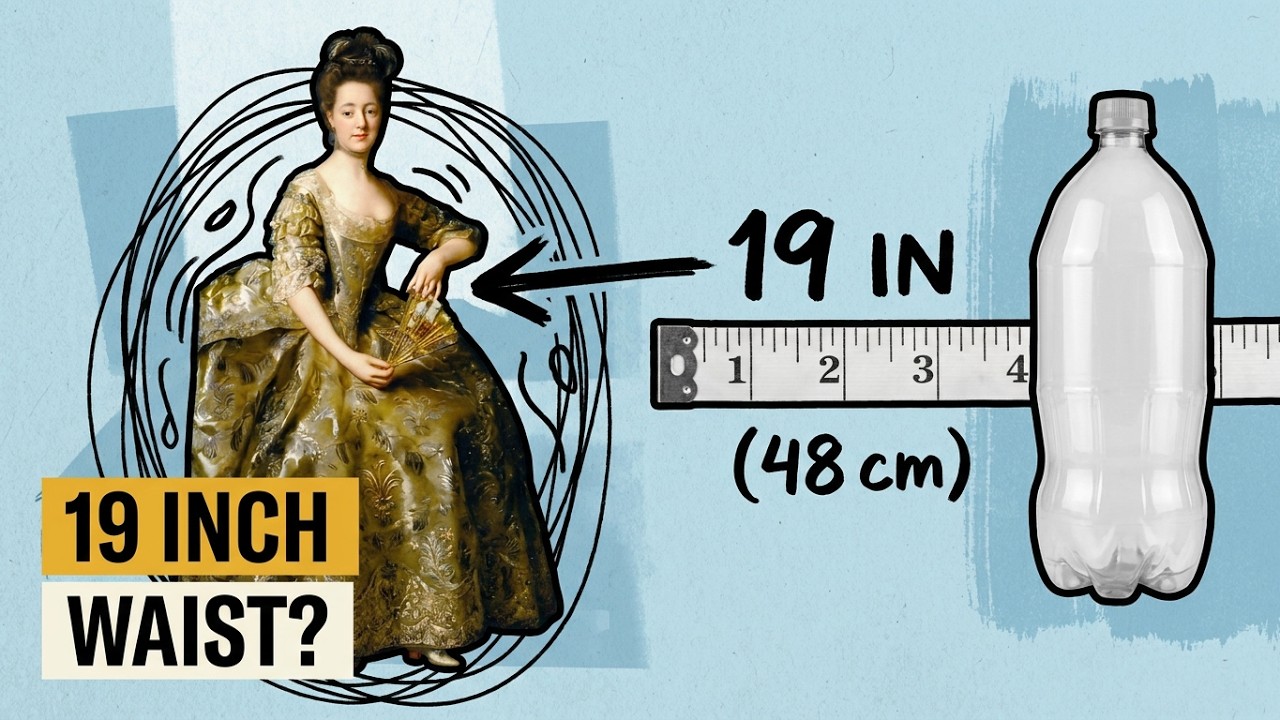
Some of Europe's most celebrated royal brides arrived at court with waists measuring just 19 inches (approximately 48 centimeters). For context, that is roughly the diameter of a standard dinner plate. These were not naturally occurring measurements. They were the result of years of deliberate, systematic lacing that began in early childhood and continued without interruption into adulthood.
Marie Antoinette was 15 years old when she crossed the border into France and entered Versailles. Her waist, her posture, and her presentation had already been engineered to meet the expectations of a court she had never set foot in. She was not unusual in this respect. She was simply one of the most famous examples of a practice that shaped the lives of royal and aristocratic girls across the continent for centuries.
Historical Background
The corset, in various forms, had been part of European fashion since at least the 16th century. By the 17th and 18th centuries, it had become a structural garment, worn not merely for modesty or shape but as an architectural statement. The silhouette it produced, a compressed waist with an exaggerated bust and hips, communicated wealth, discipline, and social rank.
For the women of Europe's royal courts, clothing was never simply personal. It was political. The way a queen or princess presented herself reflected on her dynasty, her nation, and her fitness to rule alongside, or in service of, a king. A small waist signaled self-control. Elaborate dress signaled access to resources. Youth and physical perfection signaled fertility.
Girls from royal and noble families were prepared for these expectations almost from infancy. Soft stays, the precursors to rigid corsets, were sometimes placed on very young children to encourage posture and shape. By adolescence, the lacing had tightened considerably.
What Happened
Marie Antoinette and the French Court
When the Austrian archduchess Maria Antonia, later known as Marie Antoinette, was dispatched to France in 1770, she underwent a formal ceremony at the border in which everything Austrian about her was stripped away, including her clothing. She was dressed entirely anew in French fashion before being presented to her future husband and his court.
The French court under Louis XVI maintained some of the most rigid dress codes in Europe. Marie was expected to appear in full formal court dress for public occasions, including the grand couvert, the ritual public meal that the royal family performed before assembled courtiers. These outfits, with their reinforced bodices and towering powdered wigs, could weigh over 30 pounds in total.
Her waist measurements, documented by dressmakers over the years, shifted from around 19-20 inches in her teenage years to somewhat larger figures after her pregnancies. The dressmakers' records that survive from this period offer an unusually precise window into just how physically demanding the royal standard of beauty actually was.
Hedvig Elisabet Charlotta of Sweden
Hedvig Elisabet Charlotta, who married the Duke of Södermanland (later King Charles XIII of Sweden) at 17, left behind extensive diary entries that document court life in Scandinavia during the late 18th century. Her accounts describe the social rituals of court with a dry, observational precision that historians have found invaluable.
Though her diaries focus more on court intrigue and politics than on personal discomfort, the expectations placed on her physical presentation were no different from those facing her contemporaries further south. The culture of the tight-laced waist was not confined to Paris or Vienna. It was a pan-European phenomenon tied to shared aristocratic values.
Catherine the Great: Conformity Before Power
Catherine the Great presents an interesting counterpoint. Before she became one of the most powerful rulers of the 18th century, she was a minor German princess, Sophie of Anhalt-Zerbst, dispatched to Russia at 14 to marry the future Peter III. In her early years at the Russian court, she conformed dutifully to the physical and social expectations placed on her.
It was only after she consolidated power, following the coup that removed her husband from the throne in 1762, that she began to exercise greater personal freedom in dress and presentation. Her later years showed a notable relaxation of formal constraints. But her early compliance is a reminder that even women who would later reshape history were first required to perform the same rituals of beauty and submission as everyone else.
Why It Was Strange
The strangeness of this practice is not simply that it caused discomfort. It is the degree to which the discomfort was normalized, institutionalized, and understood by those experiencing it as a reasonable cost of being female and royal.
Physical consequences of tight lacing over extended periods included:
- Restricted lung capacity, which caused fainting, particularly during strenuous court events
- Displacement of internal organs, especially the liver, which could shift visibly in women who wore stays continuously from childhood
- Muscle atrophy, as the torso came to rely on the corset for support rather than its own musculature
- Complications during pregnancy, as bodies that had been compressed for years struggled to accommodate a growing fetus
None of this was hidden knowledge. Physicians of the era wrote about the dangers of tight lacing with some regularity. And yet the practice continued, because the social cost of abandoning it, being seen as undisciplined, unfashionable, or unworthy of one's rank, was considered far more serious than the physical cost of maintaining it.
These were also girls. Marie Antoinette at 15. Catherine at 14. Hedvig Elisabet at 17. The decisions being made about their bodies were not their own. They were made by parents, courts, dressmakers, and dynasties with interests that had very little to do with the wellbeing of the individual girl at the center.
Historical Legacy
The 19th century saw renewed debate about tight lacing, particularly as the Victorian era produced its own extreme versions of the corseted silhouette. Reform dress movements emerged in the 1850s and 1870s, arguing on medical and moral grounds that the corset was damaging to women's health and dignity. These debates were often dismissed or ridiculed in mainstream fashion circles, but they planted seeds that would eventually bear fruit.
By the early 20th century, the rigid corset had begun its slow decline, replaced by lighter foundations and eventually by the more relaxed silhouettes of the 1920s. The shift was driven by a combination of factors: the practical demands of wartime work, changing aesthetic tastes, the influence of designers like Paul Poiret, and a gradual cultural renegotiation of what women's bodies were for.
But the legacy of the royal court's beauty standards did not simply evaporate. The pressure placed on women and girls to conform to externally imposed physical ideals has proven remarkably durable, even as the specific form of that pressure has changed.
What makes the stories of Marie Antoinette, Hedvig Elisabet Charlotta, Catherine, and their contemporaries worth returning to is not that they were victims in any simple sense. They were often intelligent, resourceful, and politically active within the constraints available to them. What their stories reveal is the extraordinary weight of those constraints, and the degree to which a society can normalize physical harm when it is sufficiently well-dressed.
Sources
- Lever, Evelyne. Marie Antoinette: The Last Queen of France. Farrar, Straus and Giroux, 2000.
- Ribeiro, Aileen. Dress in Eighteenth-Century Europe, 1715–1789. Yale University Press, 2002.
- Steele, Valerie. The Corset: A Cultural History. Yale University Press, 2001. https://yalebooks.yale.edu/book/9780300099539/the-corset/
- Hedvig Elisabet Charlotta. Hedvig Elisabeth Charlottas dagbok (Diary). Stockholm: Norstedt, 1902–1942. (Swedish National Archives, digitized excerpts available via Project Runeberg: https://runeberg.org)
- Alexander, John T. Catherine the Great: Life and Legend. Oxford University Press, 1989.
- Summers, Leigh. Bound to Please: A History of the Victorian Corset. Berg Publishers, 2001.
- Tortora, Phyllis G., and Keith Eubank. Survey of Historic Costume. Fairchild Books, 2009.
- The Metropolitan Museum of Art, Costume Institute. "Stays and Corsets, 17th–19th Century." https://www.metmuseum.org/toah/hd/cors/hd_cors.htm

Written by
The History, But Strange Team
We dig into the weirdest, strangest, and most forgotten corners of real history. From bizarre royal scandals to unusual medical practices and darkly funny disasters, our team researches and writes about the stories your textbooks left out.