June 19, 2026· 6 min read
The Women Who Wore Arrows in Their Hair
In the 1830s and 1840s, well-to-do women across Europe and America adorned their elaborate updos with large, ornate golden arrows, and the reasons were stranger than anyone expected.

Strange Fact
In the 1830s, if you attended a fashionable ball in London, Paris, or New York, you might have noticed something unusual about the women in the room. Nestled among their carefully constructed updos were arrows. Not decorative hairpins or subtle clips, but sizeable metal ornaments, sometimes measuring up to eight inches long, crafted from gold, silver, or polished brass and set with gemstones.
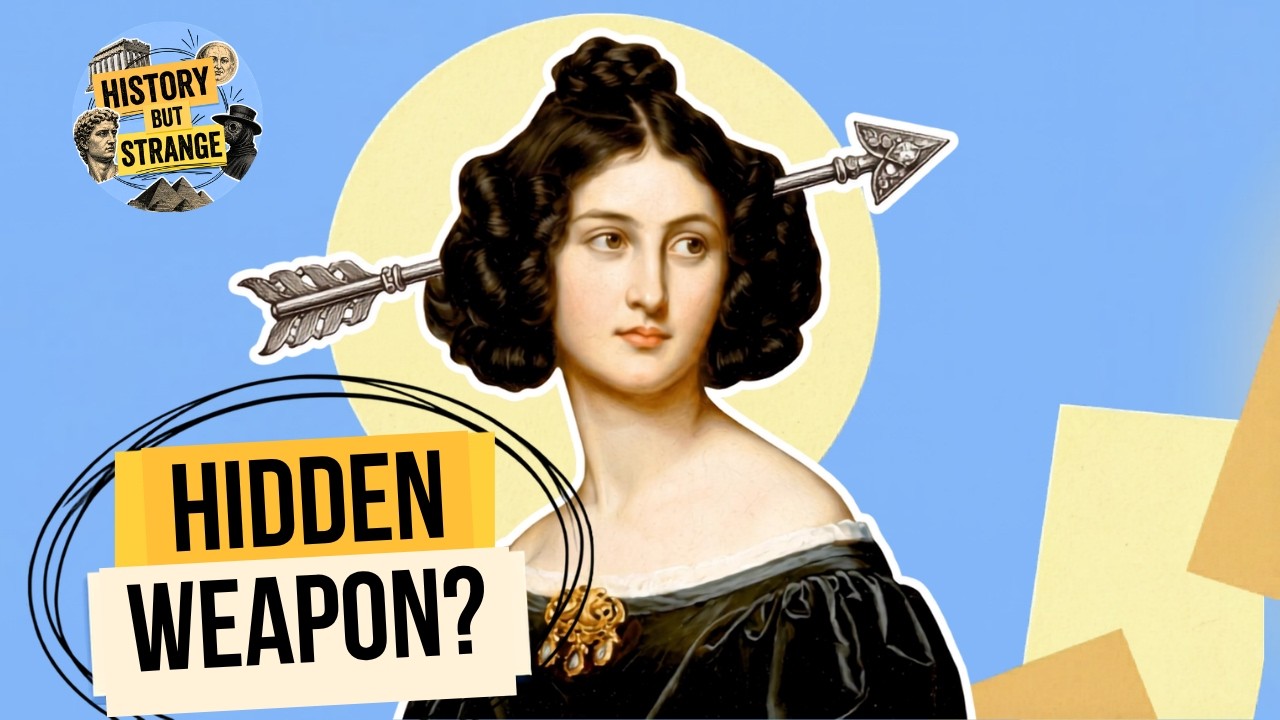
They were called Cupid's Arrows, and for roughly two decades, they were one of the most talked-about accessories in Western fashion. They were also, depending on whom you asked, simultaneously a love symbol, a feat of hidden engineering, and, if the rumors were to be believed, a weapon.
Historical Background
The early nineteenth century was a period of significant change in women's fashion. The relatively simple, high-waisted silhouettes of the Regency era gave way to something more elaborate. Sleeves grew wider, skirts billowed outward, and hairstyles became increasingly architectural.
The hairstyles of the 1830s in particular were ambitious. Women wore their hair piled high, with tight ringlets framing the face and towering arrangements of braids, loops, and curls balanced on top. Achieving this look required considerable effort, a great deal of pomade and padding, and, it turned out, some structural assistance.
At the same time, Romanticism was sweeping through European culture. Literature, painting, and music were all drenched in themes of love, longing, and classical mythology. Cupid, the Roman god of love, was everywhere. His arrows, which according to myth could make anyone fall helplessly in love, became a popular motif in jewelry, embroidery, and decorative arts.
The Cupid's Arrow hair ornament sat neatly at the intersection of these two trends: the practical need to anchor an elaborate hairstyle, and the cultural appetite for romantic symbolism.
What Happened
The ornaments themselves were remarkable objects. A typical Cupid's Arrow was not a delicate thing. Jewelers produced them in solid gold and silver, sometimes adorning them with engraved designs, coral, turquoise, seed pearls, and colored glass. The arrowhead and fletching were faithfully reproduced in miniature, making each piece instantly recognizable as what it was meant to represent.
Women would insert one or sometimes two of these arrows through their updos, angling them so the arrowhead pointed in one direction and the tail feathers emerged from the other side. In portraits and fashion plates of the period, the effect is striking. The arrow appears to have passed clean through the hair, as though Cupid himself had taken aim.
The fashion plates of Godey's Lady's Book, one of the most widely read women's magazines in antebellum America, featured these ornaments prominently throughout the 1830s and into the 1840s. Similar publications in Britain and France documented the trend with equal enthusiasm.
The Engineering Underneath
Beyond the symbolism, there was a practical logic to wearing something so substantial in one's hair. The weight and length of the arrow ornament helped stabilize the hairstyle from within. When inserted through a carefully arranged updo, the shaft acted as a structural pin, preventing the arrangement from shifting or collapsing during an evening of dancing and movement.
This was not a trivial concern. Women spent considerable time and money on their coiffures, often working with a lady's maid or a professional hairdresser. Having that investment survive an entire evening required either extraordinary luck or some hidden mechanical help. The Cupid's Arrow provided exactly that, in the most stylish package possible.
The Self-Defense Legend
Then there is the other story, the one that has given these ornaments a slightly more dramatic reputation in certain corners of popular history.
The claim holds that women carried Cupid's Arrows not merely for decoration or structural support, but as a discreet means of self-defense. Crowded ballrooms, evening salons, and carriage rides could expose women to unwanted physical contact, and the argument goes that a sharp, rigid eight-inch metal spike embedded in one's hair was a convenient, socially invisible deterrent.
Historians treat this claim with some skepticism. There is little direct documentary evidence, no contemporary accounts of a woman deploying her hair arrow against an assailant, no etiquette columns warning men away from the ornaments. What exists instead is a persistent tradition of the story being passed down, the kind of folklore that tends to accumulate around objects associated with women navigating restrictive social environments.
Whether or not any woman ever actually used one in self-defense, the idea clearly resonated. And it is worth noting that the ornaments could have served that purpose. They were, by any measure, formidable objects to have within easy reach.
Why It Was Strange
What makes Cupid's Arrows genuinely fascinating is not any single function, but the way they managed to carry so many meanings at once.
- They were romantic symbols, invoking Cupid and the language of love at a time when courtship was a serious social ritual.
- They were structural tools, solving a real practical problem with unexpected elegance.
- They were status markers, since quality examples were made from precious metals and required skilled craftsmanship.
- And they carried the shadow of a more subversive meaning, the possibility that beauty and protection could be worn as one.
Few accessories in fashion history have managed to be simultaneously a love token, a piece of hidden engineering, and a rumored weapon. Most objects get to be one thing. The Cupid's Arrow got to be everything.
There is also something quietly telling about the fact that the self-defense interpretation exists at all. Whether mythological or real, it speaks to how women in this period thought about their own position in public spaces, and how they may have sought small, invisible forms of autonomy within the considerable constraints placed on them.
Historical Legacy
The fashion for Cupid's Arrows faded by the late 1840s and into the 1850s, as hairstyles shifted again toward smoother, flatter arrangements that left less room for large ornamental insertions. The heavier architectural updos that had made the arrows so useful began to fall out of fashion, and the ornaments followed them into obscurity.
Today, surviving examples can be found in museum collections and private antique holdings. They appear occasionally at auction, where fine examples in gold and gemstones command significant prices. For collectors and curators of nineteenth-century decorative arts, they represent a small but vivid window into the material culture of the Romantic era.
For everyone else, they offer something rarer: a fashion trend that actually makes you think. Behind the whimsy of a miniature golden arrow pinned through an updo lies a full story about craft, social pressure, symbolism, and the practical ingenuity of women who needed their hair to survive a four-hour ball without assistance.
They dressed for romance. They engineered for endurance. And if the stories are to be believed, they kept their options open.
Sources
-
Severa, Joan. Dressed for the Photographer: Ordinary Americans and Fashion, 1840–1900. Kent State University Press, 1995.
-
Tortora, Phyllis G., and Keith Eubank. Survey of Historic Costume. Fairchild Books, 2010.
-
Godey's Lady's Book, various issues, 1830s–1840s. Accessible via HathiTrust Digital Library: https://www.hathitrust.org
-
Victoria and Albert Museum. "Hair and Beauty in the 19th Century." V&A Online Collections: https://www.vam.ac.uk/collections
-
Lester, Katherine Morris, and Bess Viola Oerke. Accessories of Dress: An Illustrated Encyclopedia. Manual Arts Press, 1940. Reprint accessible via Internet Archive: https://archive.org
-
Pointon, Marcia. Portrayal and the Search for Identity. Reaktion Books, 2013.
-
The Metropolitan Museum of Art. Heilbrunn Timeline of Art History, "Fashion in the Romantic Period": https://www.metmuseum.org/toah/hd/19thc/hd_19thc.htm

Written by
The History, But Strange Team
We dig into the weirdest, strangest, and most forgotten corners of real history. From bizarre royal scandals to unusual medical practices and darkly funny disasters, our team researches and writes about the stories your textbooks left out.