June 19, 2026· 7 min read
The Queen Who Refused to Let Fashion Move On: Charlotte's Pannier Obsession
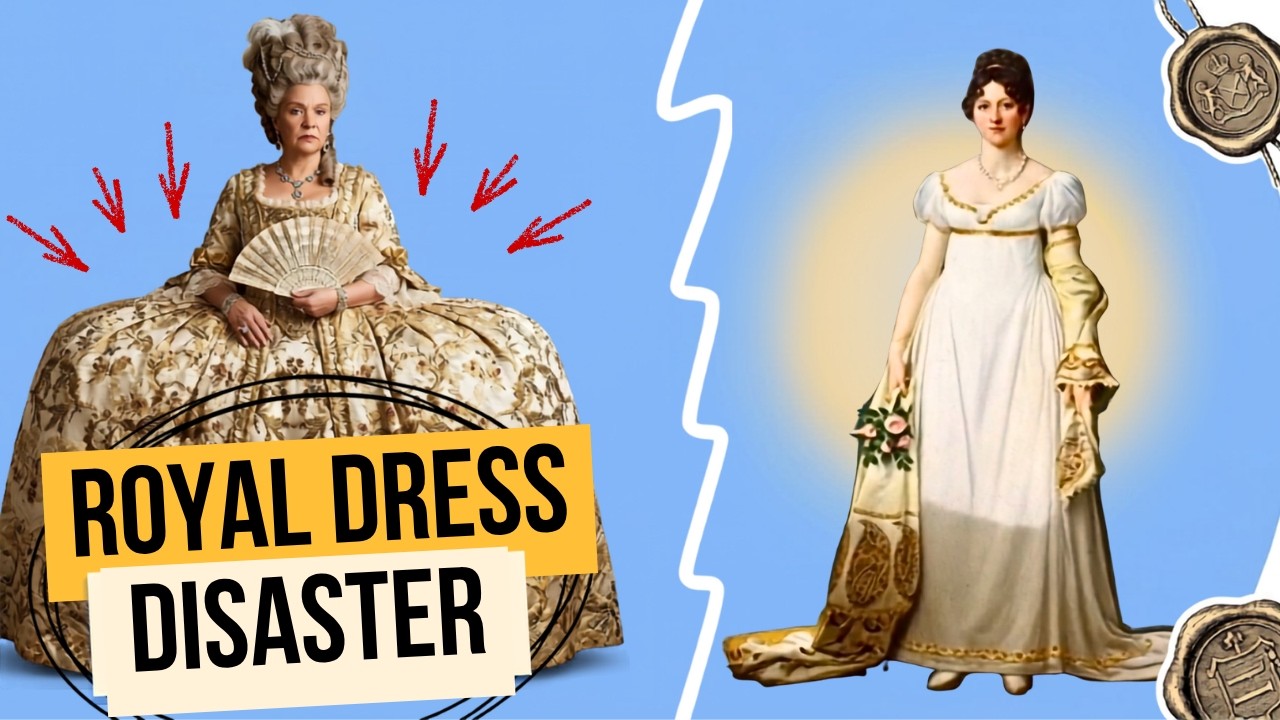
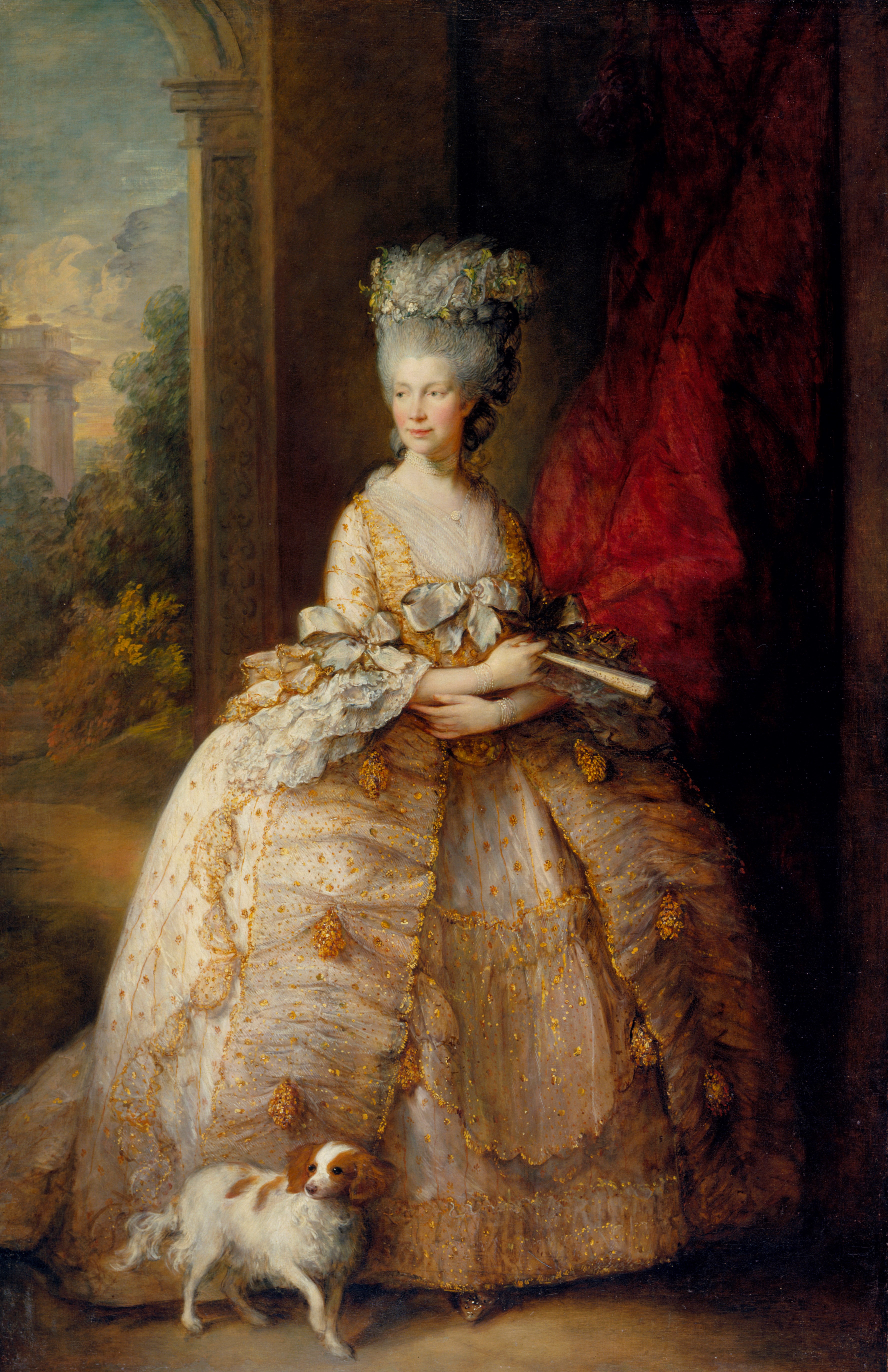
While the rest of Europe embraced flowing neoclassical gowns, Queen Charlotte kept the English court trapped inside enormous hooped skirts that could extend several feet on either side of the body.

Strange Fact
At the turn of the 19th century, fashionable women across Europe were abandoning their rigid, structured gowns for light, flowing dresses inspired by ancient Greece. In Paris, in Vienna, in Naples, the silhouette of a woman had changed almost overnight.
But not at the English royal court.
There, Queen Charlotte, wife of King George III, was holding the line. Women attending her court were required to wear panniers: wide, hooped understructures that pushed skirts outward to extraordinary widths, sometimes extending several feet on either side of the wearer. These were not a minor eccentricity. They were an architectural statement, a physical imposition, and, to many of the women forced to wear them, a source of genuine misery.
The question is: why did she do it, and how long did it last?
Historical Background
The Rise and Fall of the Pannier
Panniers (from the French word for "baskets") had been a dominant feature of aristocratic women's fashion since roughly the 1710s. At their peak in the mid-18th century, they produced some of the most extreme silhouettes in the history of Western dress. Wide, flat, and symmetrical, they required doorways to be navigated sideways and made sitting in an ordinary chair essentially impossible.
They were closely associated with the formality of continental royal courts, particularly the French court of Versailles under Louis XV and Louis XVI. Extravagance was the point. The sheer impracticality of the garment signaled that the woman wearing it did not need to do anything as ordinary as walk freely or carry objects.
By the 1790s, however, panniers had largely disappeared from fashionable European dress. The French Revolution had made such overt aristocratic display not just unfashionable but dangerous. In their place came neoclassical gowns: high-waisted, loosely draped, and deliberately reminiscent of the clothing seen on ancient Greek and Roman statuary. These dresses moved with the body rather than against it.
Queen Charlotte's Position
Charlotte of Mecklenburg-Strelitz had married King George III in 1761 and had spent decades at the center of British royal life. She was by most accounts a serious, disciplined, and tradition-minded woman. She had strong views about what royal dignity required, and those views extended to dress.
For Charlotte, the elaborate court dress was not merely a fashion choice. It was a marker of rank, an expression of institutional authority, and a visible boundary between royalty and the ordinary world. Abandoning it, in her view, would mean abandoning something essential about what the court was.
What Happened
As neoclassical fashion swept through European society in the late 18th and early 19th centuries, the English royal court became something of an island. Ladies attending Queen Charlotte's drawing rooms and formal court events were expected to appear in full court dress, complete with panniers, elaborate bodices, and towering headdresses.
The practical consequences were significant. The state rooms at Windsor Castle and St. James's Palace, while grand, were not designed for the extreme widths that panniers required. Women navigated corridors and doorways with considerable difficulty. Ballrooms became exercises in careful spatial management.
Complaints were common, though rarely made directly to the Queen. Noblewomen wrote in letters and diaries about the discomfort and the indignity of being required to wear garments that the rest of educated society had long since abandoned. Some found creative ways to minimize their attendance at events where the dress requirement applied. Others, more pragmatically, simply complied and said nothing.
The requirement was not optional. Attending a royal drawing room in anything other than approved court dress would have been a serious breach of protocol, one with real social and political consequences for families dependent on royal favor.
The Role of George, Prince of Wales
The figure who most visibly embodied the tension between Charlotte's conservatism and the wider cultural moment was her own son, the Prince of Wales, later King George IV.
George was everything his mother was not, at least in matters of personal style. He was deeply interested in contemporary fashion, a patron of Beau Brummell and the emerging culture of Regency elegance, and actively engaged with the aesthetic conversations happening across Europe. His tastes ran toward the refined and the modern rather than the elaborate and the traditional.
As the Prince's influence grew, particularly after his father's mental incapacity led to the Regency period beginning in 1811, the atmosphere at court began to shift. Charlotte's authority, though never entirely eclipsed, operated within a changed political and cultural context. The rigid formality she had maintained began to feel increasingly at odds with the era it inhabited.
Her death in 1818 effectively ended the formal requirement for the old court dress. The panniers, so long enforced by her personal authority, had no comparable champion after her.
Why It Was Strange
What makes this episode genuinely unusual is not simply that Queen Charlotte had conservative taste. Plenty of people have conservative taste.
What is striking is the degree of institutional power she wielded over something as personal as clothing, and the length of time she sustained it against the direction of broader culture.
For decades, women entering the English royal court were required to wear garments that:
- Had been functionally obsolete in fashionable European dress since roughly the 1790s
- Created genuine physical difficulty in navigating the spaces they were worn in
- Were viewed by many of the women required to wear them as outdated and uncomfortable
- Stood in direct visual contrast to the aesthetic ideals dominating the wider culture
There is also something worth noting about the asymmetry of the situation. The Queen herself held the authority. The women subject to her requirements held very little. Attending court was not merely a social pleasure but a political and economic necessity for many aristocratic families. Refusing was rarely a realistic option.
The whole arrangement illustrates, with unusual clarity, how dress codes function as expressions of power rather than simply expressions of preference.
Historical Legacy
The story of Queen Charlotte's court dress requirements is a small but useful case study in how institutions resist change even when the surrounding culture has moved on.
Fashion history tends to treat the shift from 18th-century structured dress to Regency-era neoclassicism as a clean transition. In reality, it was messy, contested, and uneven. Pockets of resistance existed, and the English royal court under Charlotte was one of the most prominent.
Charlotte's panniers also sit within a longer history of court dress as political theater. The requirement to appear in a specific, elaborate, and expensive garment before royalty has roots going back centuries and continued, in modified forms, well into the 20th century. The British royal court only formally abolished its court presentation dress requirements in 1958, when Queen Elizabeth II ended the tradition of debutante presentations.
Queen Charlotte herself has experienced something of a cultural revival in recent years, largely due to her portrayal in the Bridgerton television series and its spin-off, which imagined her as a central figure in Regency society. This renewed interest has brought renewed attention to her actual historical record, including her famously rigid court dress requirements.
The panniers she insisted upon are now held up, with some irony, as a symbol of the very traditionalism the Regency era eventually displaced. They serve as a reminder that even in periods of rapid change, someone is always trying to hold the past in place, usually by making other people wear it.
Sources
- Ribeiro, Aileen. Dress in Eighteenth-Century Europe, 1715-1789. Yale University Press, 2002.
- Pointon, Marcia. Portrayal and the Search for Identity. Reaktion Books, 2013.
- Staniland, Kay. "Court Dress." The Victoria and Albert Museum, https://www.vam.ac.uk
- Cumming, Valerie. A Visual History of Costume: The Seventeenth and Eighteenth Centuries. Batsford, 1984.
- The Royal Collection Trust. "Queen Charlotte." https://www.rct.uk/collection/themes/trails/queen-charlotte
- Hart, Avril, and Susan North. Fashion in Detail: From the 17th and 18th Centuries. Victoria and Albert Museum, 1998.
- Worsley, Lucy. Courtiers: The Secret History of Kensington Palace. Faber and Faber, 2010.

Written by
The History, But Strange Team
We dig into the weirdest, strangest, and most forgotten corners of real history. From bizarre royal scandals to unusual medical practices and darkly funny disasters, our team researches and writes about the stories your textbooks left out.